Author: Green Mountain Club

  • Ready for Rescue: Essential Tips for Outdoor Safety

    Ready for Rescue: Essential Tips for Outdoor Safety

    This article appears in the Summer 2023 Long Trail News and was adapted from a presentation by Vermont Search and Rescue Coordinator Drew Clymer.

    Most of us know and follow routine hiking safety procedures. We understand the importance of hiking in groups rather than alone, and leaving our plans with someone at home, so they can act if we don’t return. But there’s more to know than that. 

    Drew Clymer, recently appointed Vermont’s Search and Rescue Coordinator, brings a wealth of experience in backcountry emergency response to his new job, thanks to his time with Stowe Mountain Rescue, an all-volunteer organization trained in sophisticated search and rescue techniques often used on the steep, rocky slopes of Mount Mansfield, Smuggler’s Notch, and elsewhere in the state. 

    Drew recently delivered an outstanding winter Taylor Series talk on the subject for GMC’s Bread Loaf Section that covered the logistics and practices of search and rescue operations in Vermont, and provided practical safety tips for backcountry hikers. He acknowledged that even experienced hikers don’t always take all the recommended safety precautions. That can substantially complicate rescue if it’s needed.  

    Here is his “Ready for Rescue” plan —steps hikers of any age, ability or experience can take to put rescuers in the best possible position to help in an emergency. It expands upon the HikeSafe Hiker Responsibility Code, which urges hikers to be prepared, stay together, turn back if necessary, be informed about the trail and its conditions, and carry supplies for emergencies. 

    Pick Your Partners

    Many of us love the peace and solitude of hiking alone, or don’t know others who want to hike at our pace or on our schedule. It’s wise to choose solo outings carefully and conservatively, and recognize that hiking in groups is generally safer. 

    Drew adds these caveats: 

    Pick your hiking partner(s) thoughtfully. Ask yourself, do we have the same objective? What are the fitness levels in the group? Is everyone willing to hike at the pace of the slowest? What skills and knowledge does the group have? If the answers check the boxes, go with the group, and do not separate. Share knowledge and risk tolerances. 

    Leave Your Plans

    We’ve heard this one often: Tell someone where you are going and when you plan to return. This information can be crucial for search and rescue (SAR) personnel to know where to start and how to search efficiently. Give your emergency contact enough detail for rescuers to avoid wasting time. 

    1. Leave your plan with someone who will notice if you don’t return. As a backup, you can also leave a copy of your plan on your car. 
    2. Be specific. Instead of “I’m going to hike Camel’s Hump,” add details: “I’ll park at the Burrows Trailhead, go up the Forest City Trail, take the Long Trail south to the summit, and return via the Burrows Trail. I plan to start around 9 a.m., and should summit no later than 11 a.m. I plan to get back to my car by 2 p.m.” 
    3. Tell your contact what to expect. Will you check in by text when starting, turning around, or finishing your hike? What time will you be back? (Give yourself a reasonable buffer!) 
    4. Tell them where you’ll park, and describe your car. 
    5. List who is going with you and their phone numbers. If your emergency contact can’t reach you, knowing the other members of your party can be invaluable. Ask your contact to answer calls from unknown numbers, which might be from SAR members. 
    6. Explain what to do if you’re late: try to call you, or failing that, other members of your party. If they can’t reach anyone, drive to the trailhead to check on your car. Ask them to call SAR if it’s still there. 
    7. The call: In Vermont, thanks to Drew and his network, your emergency contact needn’t track down the particular law enforcement or search and rescue agency near you. They can just call 911, and the proper resources and personnel will be mobilized. 

    OK, I think I need help

    Your emergency contact knows what to do, but there are also steps you can take to limit your risk in an emergency. If you’re thinking “I might need help soon,” you definitely do need help. Now. Calling for help early can make the difference between a quick save and a strenuous, hours-long rescue. Experienced hikers may feel embarrassed to call for help, but Drew reminds us: anyone can wander off trail or twist an ankle. And many incidents can be resolved with a simple phone call. 

    When you call, try to give the operator the information they might need to evaluate the severity of your case. Stay calm, and compose your thoughts before placing a call. You may even want to write down a list of details so you don’t miss one. SAR responders will seek:

    1. Names and dates of birth of the caller and others in the party 
    2. Number in the party 
    3. The number of a call-back cell phone and its charge percentage 
    4. Location as closely as possible 
    5. Reason for the call 
    6. Weather and terrain where you are  
    7. Preparation and condition of the injured subject (if there is one), and of the rest of the party. For example, if someone has broken an ankle, do they have adequate clothes, food, and water while they await help? 
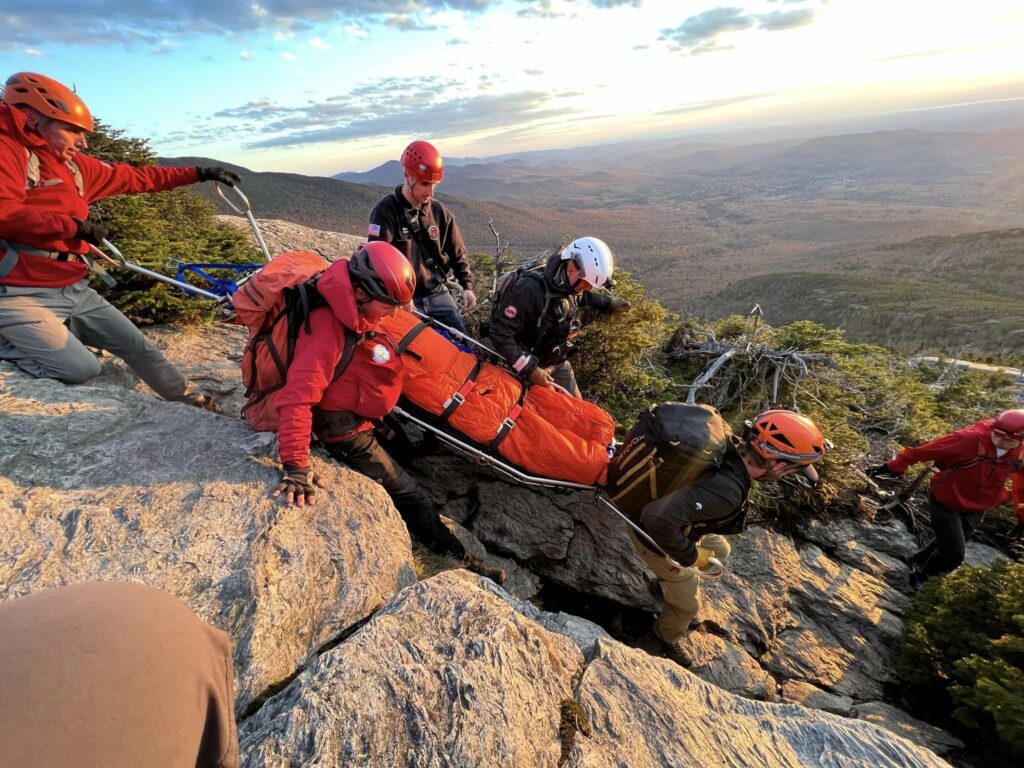
    Drew leads a litter carry on the Long Trail near Bolton.
    The contents of a hiker’s pack, with the ten essentials. Photo by Matt Heller

    Be Your Own First Responder

    It can take hours for SAR personnel to arrive, especially in a very remote location. If it took you two hours to hike in, it’s going to take rescue personnel at least as long, because they will be carrying heavy equipment and it may be dark. 

    Before leaving your car, make sure you have everything (refer to the “Ten Essentials” as a starting point) to keep yourself and your party safe and as comfortable as possible. This includes spare dry, warm clothing, extra calorie-dense food, water, headlamp (and maybe a spare), first aid kit, and a way to make a fire. Some form of shelter can save lives—a bivy sack, a large contractor’s plastic trash bag, or a lightweight tent without poles. Consider a Wilderness First Aid course to prepare yourself for mishaps. 

    A note on cell phones

    Cell phones can be very helpful, but they are far from infallible. Your carrier may not have service in remote locations, though phones will use any available signal to contact 911. Batteries can drain quickly, especially if it’s cold or if the phone is used for navigation, as a flashlight, or to capture photos and video. You should use other devices for these functions (including a waterproof map!), and keep your phone on airplane mode to preserve its battery for when you truly need it.  

    Drew also highly recommends personal locater beacons like the Garmin InReach. These GPS-equipped devices do not need a cell signal and can send a preprogrammed message to assuage worries or call for help. User errors have sometimes caused unneeded SAR responses, but Drew and his team still strongly prefer hikers have these life-saving devices. 

    A few key precautions can improve your chances of a good ending even if something goes wrong. Following the easy steps above will help make you and your group “ready for rescue.” 

  • Sounds and Stories on the Long Trail

    Sounds and Stories on the Long Trail

    This is a guest post by Tess “Storyteller” Rowan, LT Class of 2025, who has produced an audio documentary of her experience on the trail called “Field Notes: A Long Trail Odyssey.”

    “I wish the world were more like the trail.” These words from a hiker on the Long Trail have stuck with me since we spoke about our love for the Green Mountains last June.

    I set out on the Long Trail to capture the sounds and stories of America’s oldest long-distance hiking trail in an audio documentary project called Field Notes: A Long Trail Odyssey. While thru-hiking 272-miles across Vermont, I interviewed fellow hikers and community members, and recorded the rhythms of trail life.

    I found out about the world of thru-hiking when I was 14 while writing a musical, Static. I was looking for a place to set my story and became inspired by the sounds of mountains and Morse code. So, I wrote a story about a teenage girl who had a radio and lived in the woods on the Appalachian Trail. Then, I discovered that before there was the Appalachian Trail, there was a historic footpath in Vermont: the Long Trail. I had no idea how to write a musical, much less how to play an instrument, and I definitely knew nothing about thru-hiking. But I became hooked, dreaming of telling stories and long-distance backpacking.

    Photo: Cruise Control

    Six years later, in spring 2025, my college announced a summer theater grant opportunity. I reached out to the Green Mountain Club with the idea to create an immersive audio documentary about the Long Trail, sharing the power of community and conservation. With the support of the GMC and the project grant, I became a 20-year-old theater kid embarking on my first thru-hike.

    On the Long Trail, I hiked through the mud and rain, became overwhelmed by the joy and kindness of the trail community, and was in awe of the natural beauty of the land protected by the Green Mountain Club. Along the way, I was given the trail name “Storyteller.”

    After completing the Long Trail in 23 days, I came home with countless memories and hours of audio recordings to sift through. Some of my favorite recorded moments were a surprise encounter with a moose on Jay Peak, an uplifting conversation with a Mount Mansfield backcountry caretaker, and the infectious laughter of my trail family while hitching a ride for the first time. I wanted the final project to share an authentic trail experience, from brutal falls in the mud to reaching mountain summits.

    In this 45-minute audio experience, audiences are encouraged to go on a walk and press play. Through sound and stories, listeners can explore the heart of the Green Mountains on the Long Trail end-to-end.

    I’m releasing Field Notes: A Long Trail Odyssey into the world this Earth Day, April 22. I hope you listen and recall fond memories of your own time on the trail, or are inspired, like me, to take a long hike of your own.

  • Hiking Over 60: The Trail Awaits

    Hiking Over 60: The Trail Awaits

    This article first appeared in the Winter 2025 Long Trail News and was written by Chloe Miller and Philip Werner.

    Age might change how we hike, but it doesn’t have to stop us from doing it. Many people start in their 60s, 70s, or even later. Hiking connects you to the world around you — and perhaps more importantly, to yourself.

    Whether you want to get back into hiking after many years away, or want to start hiking in your 60s (or have a friend who wants to!), author and hiker Philip Werner has some advice. Philip wrote Hiking Over 60: A Modern Guide to Hiking Gear and Techniques for Active Adults, and recommends starting small and building confidence as you go.

    “In the last 20 years, hiking culture and gear have changed significantly, favoring lighter-weight gear that makes hiking more accessible for older adults. I wanted to explain the basics, for both beginner hikers and those with more experience who might be getting back on the trail after a hiatus,” Philip says of his book.
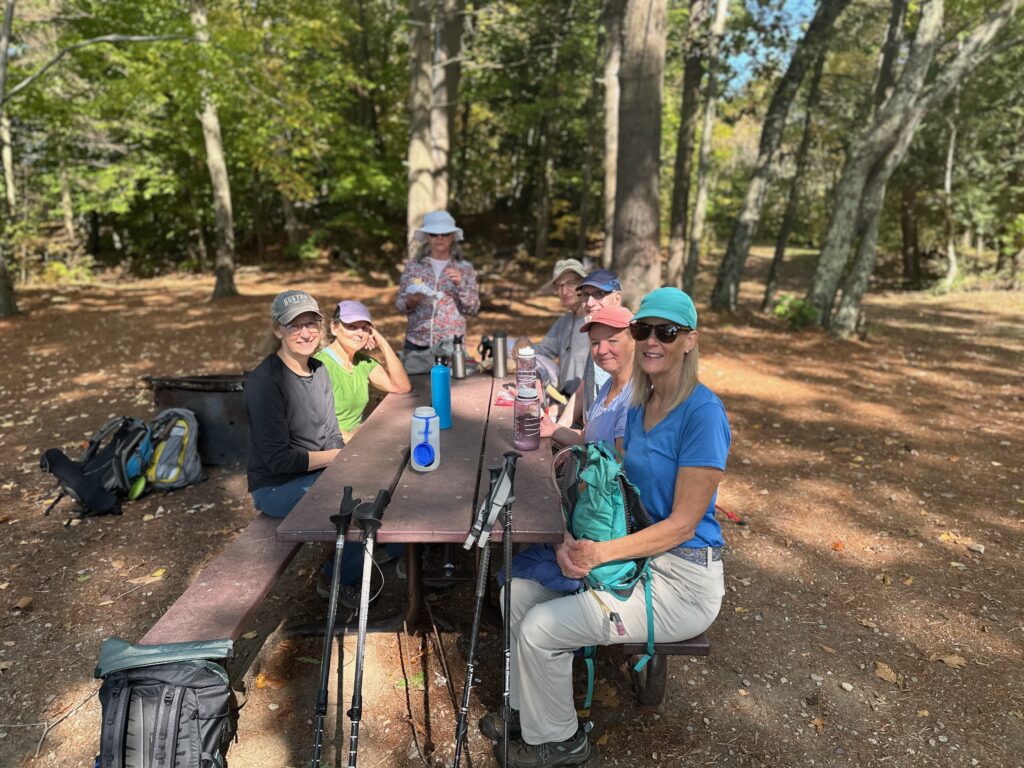
    This fall, Philip, a new GMC board member, led three group hikes geared at older adults: Haystack Mountain in Wilmington; Mt. Pisgah in the Northeast Kingdom; and Silver Lake in Salisbury.

    “It was a gorgeous, warm October day, with great autumn color. One member of our party was an amateur botanist and identified the fungi, moss, and ferns we passed along the way. Another had just had a double hip replacement less than two months earlier. She had registered because she felt the pace, geared toward mature hikers, would allow her to keep up.”


    Exploring Silver Lake in the Moosalamoo National Recreation Area. I” had originally planned a hike to Rattlesnake Point but decided to scale it back to make it more accessible to the group,” Philip explained.

    Special Considerations for Hiking Over 60

    The right preparation enhances safety and comfort, especially for mature hikers. Whether you are new to hiking, returning to it after some years away, or want to encourage friends and loved ones to explore hiking, here are Philip’s top tips.

    Footwear
    If you can, invest in high-quality hiking boots, trail shoes, or trail runners with good arch support and ankle stability. Don’t be afraid to experiment with different footwear. Consider using insoles, especially if you already wear them in your street shoes. They can provide additional arch support or cushioning.

    Trekking Poles
    These are especially helpful for those over 60 because they:

    • Provide balance on uneven terrain.
    • Reduce strain on knees and hips during descents.
    • Improve posture and upper body engagement.

    Adapt to Changing Abilities

    Knees aching? Shorter hikes, gentler inclines, and poles help. Vision issues? Choose well-marked, wider paths. Balance concerns? Trekking poles, flat trails, and hiking with a buddy add confidence. Arthritis or joint pain? Talk to your doctor. Hiking can often help manage arthritis, especially with proper footwear, poles, and gentle terrain.

    Know Your Limits

    Your endurance and pace may differ from others, or from your younger self. That’s OK. Take breaks, don’t rush, and turn back if you’re feeling unwell or overtired.

    Avoid Slippery or Steep Trails

    Stick to trails appropriate for your skill level. Many trail apps and guidebooks state difficulty and conditions. Use them to plan accordingly. Consider recent weather and seasonal conditions as well.

  • Be Well: How Hiking Can Improve Our Mental Health

    Be Well: How Hiking Can Improve Our Mental Health

    A version of this article appeared in the Winter 2025 Long Trail News. This extended version also includes footnotes and sources. As a child on the family farm in Minnesota, I loved spending time in nature. But like many folks I know, I lost my connection to the outdoors as I grew up and took on a demanding legal career, working in New York City. But it was not sustainable for this country mouse, so after a decade I returned to Vermont (I previously attended law school here) and became a public servant working for the State of Vermont. In 2024, I experienced burnout, a state of emotional and physical exhaustion brought on by chronic stress. My nervous system was stuck in sympathetic response, unable to return to a calm homeostasis caused by the activation of the parasympathetic nervous system. Something had to change, and it did in a big way: I took time away from work and spent more time being active outdoors. Hiking became my medicine, and slowly, I was able to heal. Why did it work? Being active outdoors can provide numerous benefits to our physical and mental wellbeing. Many of us know this intrinsically, and feel better after a walk in the woods. But have you ever been curious about the science behind it? Here, we break down some of the research on the connection between the outdoors, the brain and social-emotional health.

    The Biophilia Effect

    The biophilia effect states that humans have a genetic tendency to affiliate with other forms of life and are drawn to experiences in nature1 in order to increase their physical, mental, and emotional wellbeing. There are multiple benefits of just being in nature, which include2:
    • Reduced anxiety and stress through soothing sounds, smells, and sights of nature;
    • Improved mental health by reducing depression and anxiety, improving overall mood, and enhancing cognitive function;
    • Increased creativity, productivity, concentration, and problem-solving skills;
    • Faster healing and recovery.

    Improve Brain Health

    Cardio activity (hello, walking or hiking) increases respiration and blood flow to the brain, especially the prefrontal cortex – the part responsible for focus, decision-making, and memory. Brains operate at their optimum when the body is in a state of being both active and calm.  The brain has very high metabolic demands — it accounts for at least 20% of the body’s overall energy consumption.3 Researchers at Stanford found that walking can boost creative thinking by up to 60%.4 Walking can literally promote both the growth and survival of brain cells, through the simulation of brain-derived neurotrophic factor, to enhance many of our cognitive functions and reduce risk of cognitive decline and dementia. Walking can literally promote both the growth and survival of brain cells, through the simulation of brain-derived neurotrophic factor, to enhance many of our cognitive functions, such as: (1) Improved memory, attention, and problem-solving skills; (2) enhanced focus and concentration; and (3) better decision-making and reasoning abilities.5 Outdoor movement can also help create new brain cells, especially in the hippocampus, which is vital for memory.6 Additionally, regular movement outdoors helps to maintain your brain’s overall volume and prevent the deterioration of brain tissue over time, potentially reducing the risk of cognitive decline and conditions like dementia.7   Being active outdoors, including hiking, helps more than just our brains and cognition.  Hiking is an amazing whole-body workout that strengthens our muscles, bones, balance, and our respiratory and cardiovascular systems.8

    Reduce Stress and Anxiety

    Movement has two powerful healing qualities: (1) it completes the stress cycle, telling our minds that we are safe and can shift into our parasympathetic nervous systems; and (2) it releases “feel-good” neurotransmitters like endorphins, serotonin, and dopamine, which directly reduce the levels of stress hormones, improve our overall mood, and promote a sense of well-being.9 Also, exposure to sunlight through your eyes and skin stimulates the creation of serotonin in your brain, a neurotransmitter that regulates our mood, enables feelings of social connection and contributes to a healthy self-image and confidence.

    Try an Awe Walk

    Adding an element of mindfulness to your movement powers up these healing benefits. Mindfulness is the awareness of being present and fully engaged with the present moment — free from distraction or judgment. To incorporate mindfulness there are 3 elements to bring you into the present moment: (1) choose what you put your attention on; (2) place your awareness in the present moment; and (3) simply observe and be curious about the small wonders unfolding all around you, instead of judging your experiences. In a recent study, researchers coined this mindful moment outdoors an “awe walk.10 “Awe is partly about focusing on the world outside of your head…and rediscovering that it is filled with marvelous things that are not you.”  Feeling a sense of awe improves feelings of happiness and can increase your overall mood, as well as lessen negative emotions and decrease the overall amount of stress hormones in the body, which lead to body-wide inflammation.11 There is a reason why so many people feel a pull to being active in nature: we feel more positive and happier during and after these experiences.  And only 5 minutes can be enough to increase your executive functioning, processing speed and working memory.12 Feeling a sense of awe improves feelings of happiness and can increase your overall mood. It can lessen negative emotions and decrease the overall amount of stress hormones in the body, which lead to body-wide inflammation. There is so much awe to behold all around Vermont; just get outside to experience it!

    Find a Friend

    Another tremendous way to increase the benefits of hiking is doing it with another being, either human or pet.  Being active outdoors with another person can enhance feelings of safety, which is calming to the nervous system. It also improves relational health and deepens social connections through shared experiences and memories. Being in company with others can also generate oxytocin, which reduces stress hormone levels. There is a reason why so many people feel a pull to being active in nature: we feel more positive and happier during and after these experiences. As little as five minutes can be enough to increase your executive functioning, processing speed and working memory.

    Join Me for a Hike and Restorative Yoga: January 3 and February 28, 2026

    I have found that the key to my increased and sustainable wellbeing is to engage in activities that I enjoy with others.  My body no longer craves the adrenaline and stress of mountain biking or trail running.  Hiking is the perfect balance of both effort and effortlessness, so it doesn’t stress me out.  To maximize the healing benefits of mindfulness, join me for a morning hike up Stowe Pinnacle followed by a Restorative Yoga class at the GMC Visitor Center.  The hike is moderately challenging, but the yoga is ZERO effort, completely accessible to beginners.  Essentially, you are guided into therapeutic poses supported by bolsters, blankets, straps, and blocks.  The less you do, the more you gain because your nervous system shifts into the parasympathetic system where it can rest, digest, and heal. Sign Up: January 3 Hiking and Yoga Sign Up: February 28 Hiking and Yoga

    Sources on Hiking and Mental Health


    1. One Small Step: The Mental Health Benefits of Walking Outside, Sara McCloskey (August 7, 2024).
    2.  The Biophilia Effect: Exploring the Healing Power of Nature, book review by Devon Frye in Psychology Today (January 10, 2018).
    3. A Cellular Perspective on Brain Energy Metabolism and Functional Imaging, Pierre J. Magistretti, Igor Allaman, in Neuron Volume 86, Issue 4 (May 20, 2015).
    4. BDNF mediates improvement in cognitive performance after computerized cognitive training in healthy older adults, by Nicastri CM, McFeeley BM, Simon SS, Ledreux A, Håkansson K, Granholm AC, Mohammed AH, Daffner KR. Alzheimers Dement (N Y) (August 31, 2022)
    5. Can a Nature Walk Change Your Brain?  Investigating Hippocampal Brain Plasticity After One Hour in a Forest, Sonja Sudimac, Simone Kuhn (December 1, 2024).
    6. Same as above.
    7. Benefits of Hiking, National Park Service (June 28, 2024)
    8. 5 Surprising Benefits of Walking, Harvard Health Publishing, Harvard Medical School (December 7, 2023).
    9. Burnout:  The Secret to Unlocking the Stress Cycle, by Emily Nagoski PhD, Amelia Nagoski DMA (March 26, 2019).
    10. An ‘Awe Walk’ Might Do Wonders for Your Well-being, Gretchen Reynolds, New York Times (October 1, 2020).
    11. Same as above.
    12. Walking For Just 5 Minutes Does This Cool Thing to Your Brain, Per New Science, Korin Miller, in Women’s Health Magazine (June 3, 2025).
    Samara Anderson is a lawyer and yoga teacher based in Ferrisburgh. She is a licensed attorney in Vermont and New York since 2003, and has been instructing yoga since 2013. Samara then started teaching mindfulness to stressed humans in 2016 to enable herself and others to lower stress hormone levels and continue practicing law (and being a human) in a more sustainable way. She section hiked the Long Trail from 2021-2023, and became a GMC outings leader in 2024. Samara’s yoga teachings are influenced by several yoga traditions, including: Ayurveda, Anusara, Hatha, Vinyasa, Yin, Restorative, and Kundalini. 
  • Field Notes – Winter 2025

    Field Notes – Winter 2025

    The 2025 field season was one of the more stable in my time, despite constant uncertainty concerning federal funding and operations during the government shutdown.  

    Special Projects  

    Senior Trail Technicians Andrew Muller, Matt Vezina, and Garrett Hogan started their season with emergency repairs at Clarendon Gorge Bridge. They then returned to their original schedule, building a fully accessible trail to Jean Haigh Cabin at Wheeler Pond. The woodshed and ramp to the rear deck are fully accessible, and with the privy also modified, users with a wide range of mobility can enjoy the facility. 

    The crew moved on to sill and porch repairs at Spruce Peak Shelter, installing logs the Brattleboro Section prepared last fall. Next they laid the groundwork for next year’s repairs to Taft Lodge, harvesting and de-barking logs near the Monroe Trailhead in Camel’s Hump State Park, in consultation with our partners at the Vermont Department of Forests, Parks and Recreation. They also supported the helicopter airlift of the logs to the lodge.  

    In June, the National Environmental Policy Act (NEPA) review was completed and plans approved to build an additional shelter at the popular Battell Shelter site to accommodate heavy usage there. August’s airlift delivered materials, and the crew began work immediately, concluding in October. 

    Finally, the senior tech team restored sills and replaced the floor at Beaver Meadow Lodge. Thanks go to the Sterling Section for their help on the project.  

    Dylan Norris worked with Project Coordinator Justin Towers to build a new deck, stairs, and ramp for Minerva Hinchey Shelter to make it ADA accessible, and to build a new woodshed at Bryant Camp. 

    Trail Work 

    We had two professional trail crews again in 2025. Returner Owen Maille and newcomer Jivana Esposito led the southern crew, and returner Molly Belvo led the northern crew. Both made progress on complex, multi-year projects, spending three-quarters of their seasons on one site.  

    First, the crew leaders spent a week finishing the south approach to the 2024-built Rootville Road Bridge, adding stone armor and drainage structures.  

    In two weeks the northern crew completed a turnpike begun on the Sucker Brook Trail in 2024. They then finished stabilizing Lost Pond Shelter, jacking up the shelter, removing its listing concrete piers, and setting the shelter on pressure-treated timber cribwork on pads of crushed stone, all done with hand tools in compliance with wilderness area regulations.    

    They spent their last 14 weeks relocating the Long Trail north of Route 118 on Belvidere Mountain. This was our first test of mechanized equipment to supplement hand tools. We bought a mini-excavator, and plan to train a few seasonal staff members each year so the excavator can work where it can reach the trail and it fits the character of the Long Trail System.  

    This is an important change in how we approach trail work. Machines are not practical everywhere, but they can reduce labor costs, save time, and reduce the repetitive physical and mental strain of building bench-cut trails by hand. The Belvidere reroute will be completed next year, with an anticipated opening by the end of the season. 

    The southern trail crew’s main project was installing a series of short relocations and trail hardening measures to reduce mud south of Risky Ranch Road. This comment from the U.S. Forest Service recognized the quality of their work:  

    GMC crews have come so far in the quality of work in the past five to seven years.  Wow.  It’s really good work.  I’m proud for you!” 

    They went on to four weeks on the LT north of Bromley Mountain, where they installed a staircase and a short relocation. 

    In our first 2023 flood recovery project, the southern crew built two stone staircases and a retaining wall just north of the MacArthur Bridge at Route 9. Their second flood repair project restored part of the side trail from the Lye Brook Falls Trail to the falls that a landslide had destroyed. 

    The Volunteer Long Trail Patrol (VLTP) spent its eight-week season just north of the Massachusetts line finishing a one-third of a mile relocation of the Long Trail-Appalachian Trail. We are coordinating the relocation with the AT Committee of the Appalachian Mountain Club’s Western Massachusetts Chapter. It is scheduled to open in 2027. 

    Led by Lydia Yuhas and Eric Bakken, VLTP crews cleared brush, cut tread, and built stone structures on the relocation. The relocation will replace the notoriously muddy southernmost stretch of the LT — a long-term goal — by moving the trail to higher and drier soil on a sidehill, with proper drainage and a more sustainable layout. It also moves about 1,000 feet of trail from private land to the Green Mountain National Forest, furthering our land conservation goals.  

    Caretaker Program 

    Caretakers staffed busy summits and ponds, protecting vulnerable ecosystems as a long stretch of lovely weather in late summer and early fall attracted throngs of hikers. Dry summer weather eased the work of volunteers packing bark mulch to composting sites, and we completely composted 1,215 gallons of human waste, leaving no partially composted waste to overwinter.   

    Caretaker Supervisor Sarah Bailey and Visitor Services Manager Emily Mosher launched the new Volunteer Trail Steward Program, training volunteers stationed at the Mount Mansfield Visitor Center. The program was highly successful, augmenting the club’s staff and increasing visitor contacts at the top of the Stowe Toll Road, which attracts hundreds of visitors daily.  

    — Keegan Tierney, Director of Field Programs

  • Field Season on Film

    Field Season on Film

    Field season on film

    This article was written by assistant trail crew lead Jivana Esposito and appeared first in the Fall 2025 Long Trail News.

    As I dive deeper into the trail world, I find myself extremely inspired by archival pictures of trail crews in the early 20th century, when film photography was just evolving. Photos of crews cutting trail bench into sheer hillsides, using historic power carriers and pneumatic jackhammers, and creating camp communities, which inspired how we live in the field now.

    Trail work is not a very well-known profession. Many people have a very limited understanding of what our job entails or do not take it very seriously. But what most fail to realize is that trail work is one of the oldest trades in history. That’s why documentation is so important in this field of work.

    Long before there was standardized and recreational trail building, indigenous people built trail networks to establish their communities and for ceremonial purposes. The first recreational trails aimed at tourists developed in the 1850s in California and the Northeast. Being a part of the evolution of trail design means being part of a rich and long history of good craftsmanship that can endure generations. It feels important to document my trail crew’s experience to be able to show our families, friends, and others that we did historic work while building community and strengthening our will.

    But the documentation is also an effort to show trail work as a legitimate profession that requires physically demanding labor in rustic, often-isolating settings, and in inescapable weather conditions. We are a part of something special that has gone on long before us and will continue long after us. I think capturing the season on film is just a small way we can hold onto the memories we’ve created together.

    Field season on film
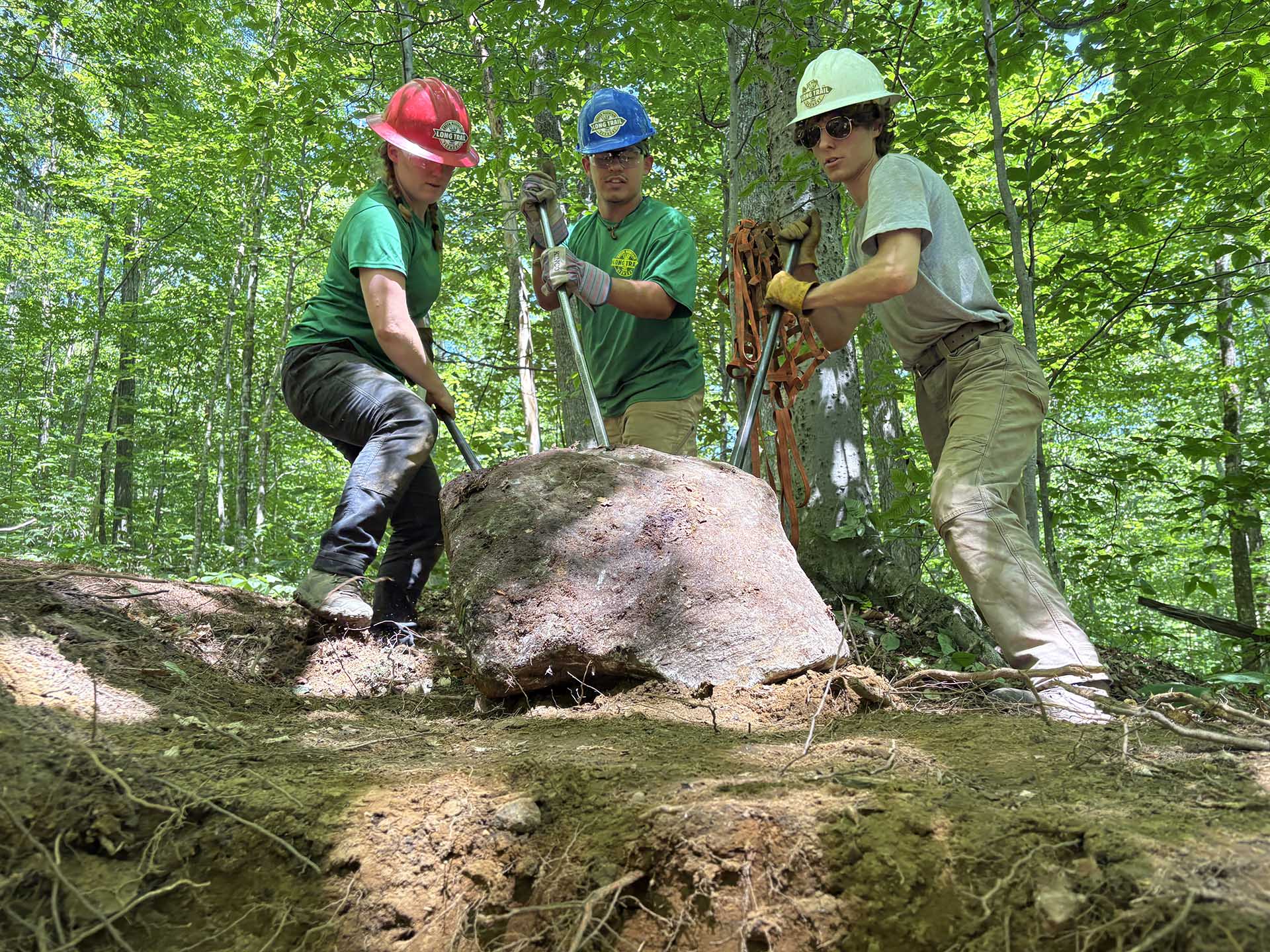
    Trail crew members use rockbars, pick mattocks, and other hand tools while working on a project near the Long Trail’s southern terminus.

    Field season on film
    Trail crew member Rio Hammond rests against a large boulder near one of the crew’s project sites on the southern Long Trail.

    Field season on film
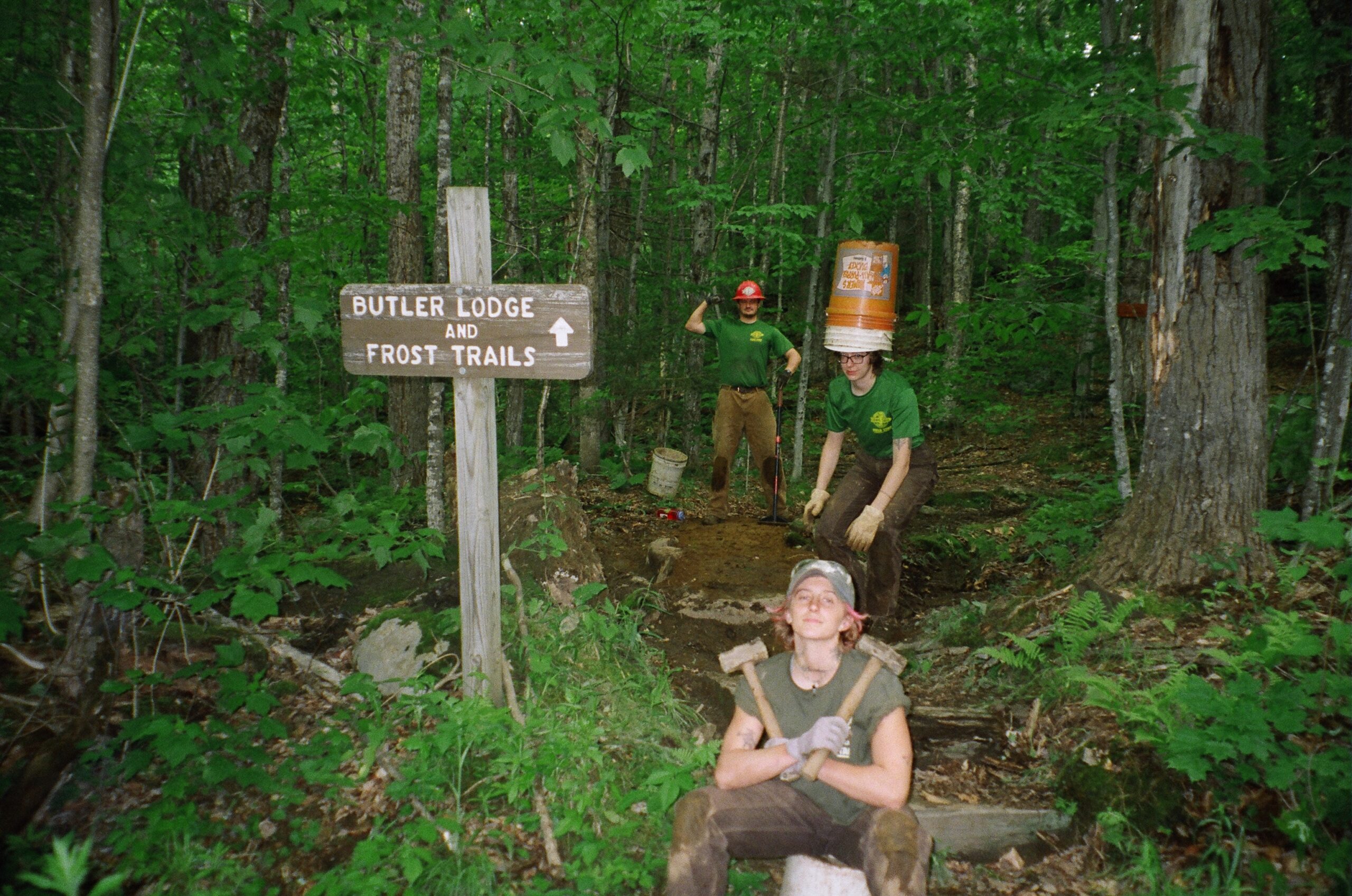
    Font to back: GMC professional trail crew leads Jivana Esposito, Molly Belvo, and Owen Maille pose during a pre-season project, where they honed some of their trail skills before meeting their crews.

    “Early in the season when we experienced days of torrential downpour, we named our camp Sun Dome, based off a short dystopian story where people living on Mars experience rain all day, every day, and have to walk thousands and thousands of miles to reach a “Sun Dome” to experience sunlight.”

    Trail crew member Rio Hammond holds up slices of watermelon during a mid-day break, delivered to the crew by a GMC section volunteer.

    “Trail crew member Lily Nylund naps in a borrow pit at our project site. Borrow pits are a trail construction technique where inorganic mineral soil is sourced from the surrounding area to use as fill for the trail, providing better structural support than organic soil.”

    “Our crew takes turns cooking for each other, with designated days to cook or clean dishes. Our kitchen experience always feels like a collaborative effort and we make sure we meet everyone’s dietary needs and restrictions.”

    Trail crew lead Owen Maille puts finishing touches on the crew’s large relocation project in southern Vermont. “He was the visionary behind this project and taught our crew a lot of tips and tricks on quality trail building.”

    “We are really proud of the work we’ve done. Within one big project, we all had our individual projects and honed our trail building skills over the course of many long, hard days.”

    Jivana Esposito was the assistant trail crew lead for GMC’s southern Long Trail Patrol crew during the 2025 field season. She previously completed the AmeriCorps Backcountry Trails Program in California and was a wildland firefighter in Oregon.

    The crew spent 10 weeks on the Long Trail/Appalachian Trail south of Risky Ranch Road, installing trail hardening structures and reroutes to alleviate the perpetual muddiness of the trail there.

  • Thru-Hiking with a Dog: Blue Blazin’ Bug

    Thru-Hiking with a Dog: Blue Blazin’ Bug

    Thru-hiking with a dog
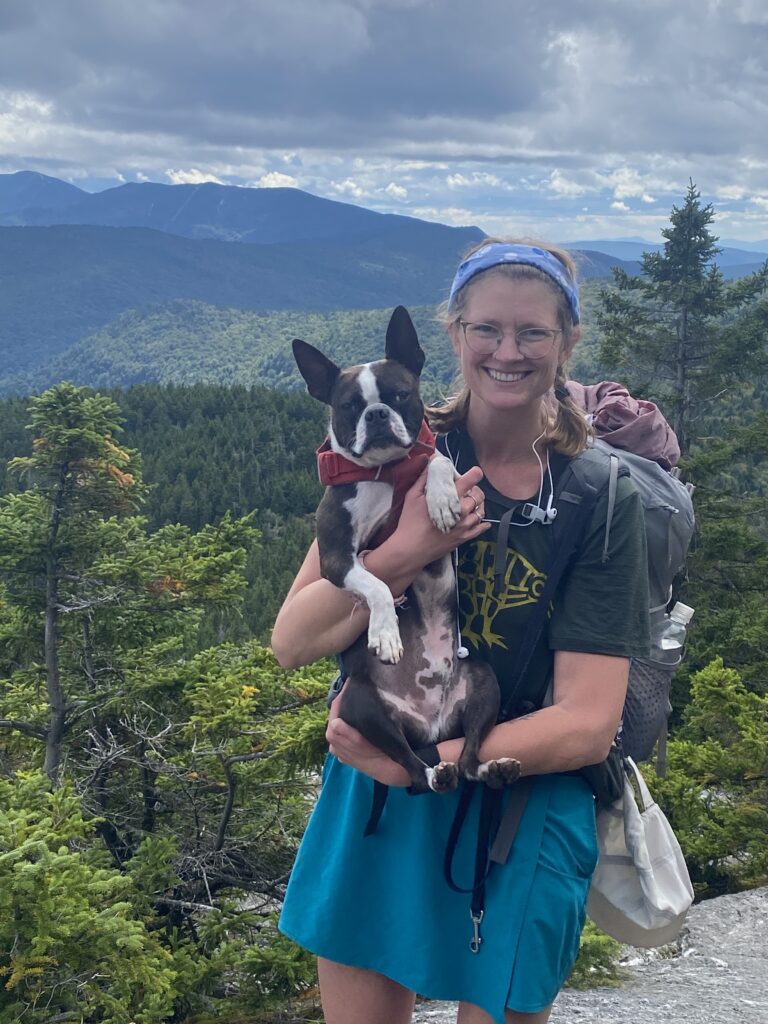
    Brooke Black and her Boston terrier, Blue-Blazin’ Bug, thru-hiked the Long Trail in 2024.

    Boston terriers probably aren’t the breed that leaps to mind when you think “long-distance hike.” With their cockeyed gaze, snubby snouts, stubby tails, and tendency to snort when they breathe, they bear a stronger resemblance to potbellied pigs than wolves.

    But appearances to the contrary, Boston terriers are dogs, and dogs love walks. So when I carved out time for a Long Trail thru-hike last year, I wanted to take my Boston, Bug, with me.

    On August 14, after a couple months of training, my dad drops us off at Pine Cobble Trail in Williamstown, Massachusetts, and our northbound thru-hike begins.

    Like all Boston terriers, Bug is hyper, jumpy, easily distractible – and highly food-motivated. So, with no other hikers around, we practice recall: I let him stray out ahead of me, then give him a whistle and a treat from the bag in my pocket when he comes running back. On day two, he starts calmly walking at my heel. On day three, he stops trying to jump all over other hikers.

    “I’ve been trying to teach him to do that since we got him!” I tell Bliss, who trains dogs back in the real world. “He just randomly decided to be well-behaved.”

    She smiles wisely. “A tired dog,” she explains, “is a good dog.”

    And a happy dog too! For Bug, life on the trail is one big walk, filled with fascinating smells, lots of treats, and a galaxy of sticks to munch on. In the real world, jumping is something he might get scolded for, but out here, it’s a superpower. He practically levitated up Bromley Mountain and Styles Peak. And every evening, he gets to eat kibble topped with people food, and then snuggle up at the foot of my sleeping bag. Yep, no complaints from Bug… that is, until stormy weather hits.

    Blue-Blazin’ Bug with his namesake trail.

    On day four, we wake up at Kid Gore Shelter to rain pounding on the roof and cascading off the wooden shingles. Bug huddles against me, ears cocked back. Classic newbie: thinks he can just sit in the shelter and wait out the rain. But we’ve got 15.2 miles to go, and we’re burning daylight. With apologies and promises of treats, I leash him and lead him from the shelter. Before long, he’s crushing miles with the grudging persistence of a thru-hiker. Dog or human, if you wanna keep warm, keep moving.

    Stratton Mountain looms in my FarOut app, and all the southbounders we meet tell us it’s slippery. One suggests skirting the mountain on the blue-blazed Stratton Pond Side Trail. I roll my eyes – I’m a purist! – but then I look down at my soggy dog, and remember that this hike isn’t about me alone. Bug doesn’t know why we’re out here, or for how long, or what color the blazes are. All he can do is trust me. I have to honor that trust.

    And that’s how my dog got his trail name: Blue-Blazin’ Bug.

    On day 17, as we traverse the Monroe Skyline, the clouds open up and rain pours down again. I decide to push through it; we’re almost off the top of the mountain, so the hard part’s over. It’s all downhill from here!

    And that’s how I learn, in the hardest way possible, about the rebar ladders of General Stark Mountain.

    Bug’s a good sport, for a while. We figure out a system where I climb down, drop my pack, climb up, offer him a treat, ease down the ladder holding him on my hip like a baby, and then give him another treat for a job well done. But even with all the soggy treats, Bug finds his breaking point. Who can blame him? For all he knows, we’re doing another 15-mile day. And so, as I climb yet another rebar ladder, he gives me a look that says, “Lady, you’re crazy,” and bolts into the woods.

    When I catch up to him a few moments later, at Theron Dean Shelter, I offer more treats, more apologies, and the leash. No way around it: It’s a cold, wet, miserable 1.7 miles. But as soon as the road comes into view, the rain lets up.

    The rebar ladders of General Stark Mountain proved challenging for the duo.

    Bug never got used to being carried down ladders (it was no picnic for me either), and he froze up at Devil’s Gulch, just like I did when I was a kid (Long Trail News, summer 2023, “I HATE HIKING!”). But he loved all the attention he’d get at camp – especially Corliss, where people literally took turns holding him in their laps. And he loved the mountains. Killington, Clarendon Gorge, Mount Abe. Even Burnt Rock Mountain and Camel’s Hump were no match for his agility and impressive ups. (Though he did yellow-blaze around Mansfield, and who can blame him, or me, for that?)

    A thru-hike is a way for a person to connect to their wild nature; turns out it can tame a dog. By the time we reached the Canadian border obelisk on September 20, Bug was a perfect gentleman.

    (It didn’t last. Now that we’re back in the real world, there are no mountains for him to levitate up. He has to settle for jumping all over people.)

    Brooke Black grew up in Fairfield and currently lives in Michigan, where the hikes are decidedly flatter than in Vermont. She is the author of Luckly: An African Student, An American Dream, and A Long Bike Ride.

    *Editor’s Note: GMC requests those hiking with dogs be considerate of other hikers. Dogs should be leashed or under 100% voice control. Please leash your dogs when approaching other hikers, in the alpine zone, at overnight sites, trailheads, and near water sources. Visit this GMC blog article for more on hiking with dogs.

  • 2025 GMC Photo Contest Winning Photos and Other Entries

    2025 GMC Photo Contest Winning Photos and Other Entries

    Thank you to everyone who entered the 2025 GMC photo contest! In this year’s contest, members of the Long Trail hiking community shared over 200 images that capture the beauty of Vermont’s mountains, trails, and hiking community as seen through your eyes and camera lenses. Scroll through the winning photographs and a selection of other entries we just had to share! Congratulations to the 2025 GMC Photo Contest winners.

    Grand Prize

    2025 GMC Photo Contest overall contest winner
    “Spruce Ledge Sunrise,” by Mark Paquin

    Hikers’ Choice

    2025 GMC Photo Contest Hikers' Choice winning image.
    “Up for Dawn,” by Joe Iadanza

    Flora and Fauna

    2025 GMC Photo Contest flora and fauna category winner.
    “Ostrich Fern Emerging Along the Long Trail,” by Laura Knapp

    Hikers

    “Taking It In After a Hard Climb Up Camel’s Hump,” by Tara Blondin

    Landscapes and Views

    “Heading Up Camel’s Hump,” by Mickey Nowak

    Trail Features

    “Trail Junction at Bamforth Ridge Shelter,” by Barbee Hauzinger

    More Amazing Photo Contest Entries

  • Vote for the 2025 Hikers’ Choice Photo Winner

    Vote for the 2025 Hikers’ Choice Photo Winner

    With over 200 entries submitted to this year’s photo contest, it was difficult to narrow down our selections but we managed to choose 14 photos to include in the Hikers’ Choice vote. These photos embody unique or memorable elements of the hiking experience or struck our eye in a unique way. Please vote only once using the Google Form below. Voting will be open for a week, and close on Friday, September 12. Hiker’s Choice winners, along with the Grand Prize winner and winners of each of the four categories (Hikers, Scenes and Landscapes, Flora and Fauna, and Trail Features) will be announced on September 15.

    Vote Here

    Red Sumac, by Rachel Norton
     
    Resting in Different Ways, by Dana Dwinell-Yardley
     
    Hiking in the Clouds, by Gretchen Alexander
     
    First Camel’s Hump Summit, by William Tyler
     
    Mansfield in the Clouds, by David Casarella
     
    Walking the Puncheon, by Jackie McDaniel
     
    Up for Dawn, by Joe Iadanza
     
    Happy Holidays, by Julie Ruegsegger
     
    Red Eft, by Krista Cheney
     
    Sunset Ridge Foliage, by Leo He
     
    View of Stratton Forest Ranger Cabin from Tower, by Jim Pease
     
    Division One Pond, by Phil Hough
     
    30+ Years of Annual Solstice Hike, by Scott Barnicle
     
    Misty Dawn, by Tian Feng
     

    Vote Here

  • Battell Shelter: A Look Back and Plans for the Future

    Battell Shelter: A Look Back and Plans for the Future

    The first Battell Shelter, built 1938 in the classic Adirondack lean-to style.

    At 3,300 feet on the south side of Mount Abraham, just under a mile from the summit, the Long Trail hiker comes upon Battell Shelter. The three-sided Adirondack-style lean-to, built in 1967 by work parties from Farm and Wilderness Camp in Plymouth, sleeps eight.

    Battell Shelter is one of the highest three-sided shelters on the Long Trail System. Popular among Long Trail end-to-end hikers, and only about two miles from the nearest trailhead parking, it is also popular among novice hikers seeking a Long Trail overnight and to climb of one of Vermont’s 4000-foot summits.

    In the early 1980s I was one such hiker. It was January, and my Scout troop planned an overnight at Battell. It was my first overnight camping trip, and a memorable one. After dinner, we lay outside to look at the stars and a lunar eclipse. Tucked into the warmth of our sleeping bags, we read Jack London’s short story “To Build a Fire”, and I felt thankful I didn’t have to build a fire to survive that night.

    Early the next morning we hiked to the summit to enjoy crisp mountain air and the 360-degree view of the surrounding countryside. Climbing Mount Abraham and staying overnight at Battell in winter made a profound impact on me. It sparked a lifelong interest in astronomy, winter hiking and climbing, and led me to a career in natural resource management.

    Today’s Battell Shelter is almost 60 years old, but it is actually the fourth shelter on the mountain. The first was built in 1899 by Col. Joseph Battell for use by friends, family and guests staying at his inn in Ripton at what is now the Breadloaf Campus of Middlebury College.

    Col. Battell was a publisher, philanthropist, and early conservationist. When he died in 1915 he was Vermont’s largest landowner, having accumulated properties totaling 30,000 acres, which he bequeathed to Middlebury College and the State of Vermont to be preserved as “wild lands.” They include today’s Joseph Battell Wilderness, Breadloaf Wilderness, and Camel’s Hump State Forest.

    Unfortunately, the original Battell Lodge didn’t last as long as Battell’s land holdings. Not long after his death, Battell Lodge fell into disrepair.

    The 1924 Long Trail Guide read: “This Log cabin in bad repair: affords shelter, is apt to be dirty for picnickers. Stove inside fair. No bunks. Simple cooking utensils. Fine water 1/8 mile south on trail. This Lodge built by Col. Joseph Battell in 1899 for use of his guests, fitted complete with everything needed by campers and kept open for their use. Looted and wrecked by hunters.”

    In 1926, a new shelter built by the Forestry Department of Middlebury College replaced the original Battell Lodge. More modest than the original, it was nevertheless was popular among hikers, with bunks for 10 to 12, a wood stove, and a large fireplace against a giant rock. It burned mysteriously in 1937.

    Battell Lodge, rebuilt in 1927, pictured here in the late 1930s.

    The Long Trail Patrol, led by Roy Buchanan, built a third shelter, Battell Shelter, on the site of the current shelter. This was a classic Adirondack-style open-front lean-to built of logs harvested onsite. It is reported that the privy was also made of logs to match the shelter. This shelter was replaced by the current shelter in 1967 by the U.S. Forest Service, which defines it as a Mid-Century Modern iteration of the classic Adirondack open camp style.

    In the 1950s and ’60s the Forest Service began to modernize existing overnight facilities and build new ones to handle increasing participation in outdoor recreation. Shelter plans reflected post-war modern touches, like milled sheathing and dimensional framing instead of logs, three-tab asphalt roofing shingles, and poured concrete piers. The minimalist design emphasized function over aesthetics, and could be prefabricated offsite and airlifted to a site.

    Battell Shelter in 2025 shows the need for repairs and expanded capacity. Photo by Keegan Tierney.

    As GMC begins our 2025 field season, we are working with the Forest Service to plan the next iteration of the Battell overnight site. We need to increase capacity and improve the hiker experience while protecting vulnerable high-elevation vegetation from impacts of overuse. Because of the current shelter’s historical and architectural significance, we will likely build a new shelter next to it rather than replace it. The club will continue to station a backcountry caretaker at the site in the hiking season to help manage it. We will share details of the final plans later this year.

    As the Battell Shelter site continues to evolve, it will undoubtedly remain important and popular for generations of hikers traveling Vermont’s footpath in the wilderness. Thanks to the ongoing support of members and donors like you, we can preserve both the historic shelter site and the fragile alpine vegetation surrounding this beloved overnight site.