Category: Field Notes

  • Field Notes – Winter 2025

    Field Notes – Winter 2025

    The 2025 field season was one of the more stable in my time, despite constant uncertainty concerning federal funding and operations during the government shutdown.  

    Special Projects  

    Senior Trail Technicians Andrew Muller, Matt Vezina, and Garrett Hogan started their season with emergency repairs at Clarendon Gorge Bridge. They then returned to their original schedule, building a fully accessible trail to Jean Haigh Cabin at Wheeler Pond. The woodshed and ramp to the rear deck are fully accessible, and with the privy also modified, users with a wide range of mobility can enjoy the facility. 

    The crew moved on to sill and porch repairs at Spruce Peak Shelter, installing logs the Brattleboro Section prepared last fall. Next they laid the groundwork for next year’s repairs to Taft Lodge, harvesting and de-barking logs near the Monroe Trailhead in Camel’s Hump State Park, in consultation with our partners at the Vermont Department of Forests, Parks and Recreation. They also supported the helicopter airlift of the logs to the lodge.  

    In June, the National Environmental Policy Act (NEPA) review was completed and plans approved to build an additional shelter at the popular Battell Shelter site to accommodate heavy usage there. August’s airlift delivered materials, and the crew began work immediately, concluding in October. 

    Finally, the senior tech team restored sills and replaced the floor at Beaver Meadow Lodge. Thanks go to the Sterling Section for their help on the project.  

    Dylan Norris worked with Project Coordinator Justin Towers to build a new deck, stairs, and ramp for Minerva Hinchey Shelter to make it ADA accessible, and to build a new woodshed at Bryant Camp. 

    Trail Work 

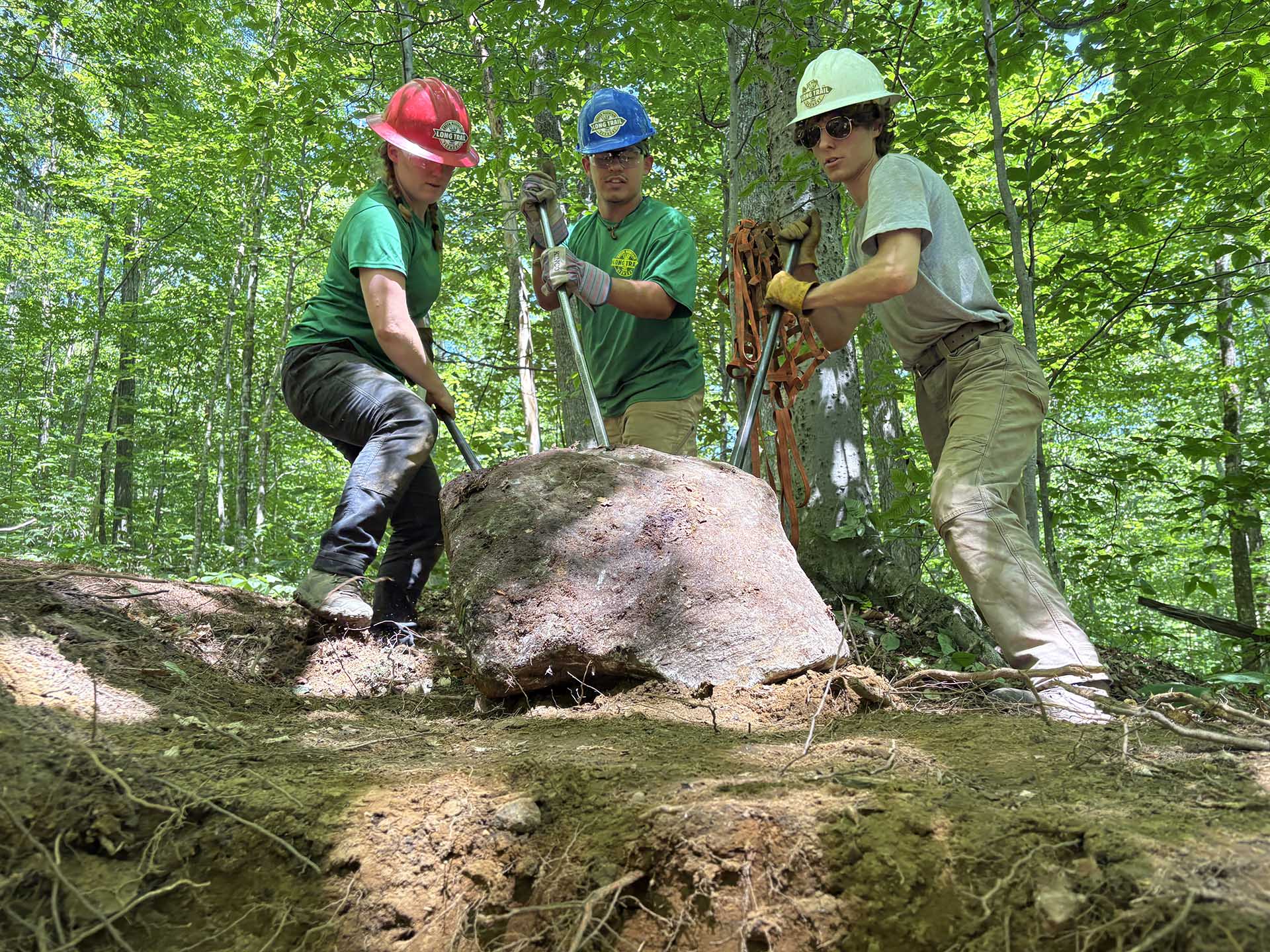
    We had two professional trail crews again in 2025. Returner Owen Maille and newcomer Jivana Esposito led the southern crew, and returner Molly Belvo led the northern crew. Both made progress on complex, multi-year projects, spending three-quarters of their seasons on one site.  

    First, the crew leaders spent a week finishing the south approach to the 2024-built Rootville Road Bridge, adding stone armor and drainage structures.  

    In two weeks the northern crew completed a turnpike begun on the Sucker Brook Trail in 2024. They then finished stabilizing Lost Pond Shelter, jacking up the shelter, removing its listing concrete piers, and setting the shelter on pressure-treated timber cribwork on pads of crushed stone, all done with hand tools in compliance with wilderness area regulations.    

    They spent their last 14 weeks relocating the Long Trail north of Route 118 on Belvidere Mountain. This was our first test of mechanized equipment to supplement hand tools. We bought a mini-excavator, and plan to train a few seasonal staff members each year so the excavator can work where it can reach the trail and it fits the character of the Long Trail System.  

    This is an important change in how we approach trail work. Machines are not practical everywhere, but they can reduce labor costs, save time, and reduce the repetitive physical and mental strain of building bench-cut trails by hand. The Belvidere reroute will be completed next year, with an anticipated opening by the end of the season. 

    The southern trail crew’s main project was installing a series of short relocations and trail hardening measures to reduce mud south of Risky Ranch Road. This comment from the U.S. Forest Service recognized the quality of their work:  

    GMC crews have come so far in the quality of work in the past five to seven years.  Wow.  It’s really good work.  I’m proud for you!” 

    They went on to four weeks on the LT north of Bromley Mountain, where they installed a staircase and a short relocation. 

    In our first 2023 flood recovery project, the southern crew built two stone staircases and a retaining wall just north of the MacArthur Bridge at Route 9. Their second flood repair project restored part of the side trail from the Lye Brook Falls Trail to the falls that a landslide had destroyed. 

    The Volunteer Long Trail Patrol (VLTP) spent its eight-week season just north of the Massachusetts line finishing a one-third of a mile relocation of the Long Trail-Appalachian Trail. We are coordinating the relocation with the AT Committee of the Appalachian Mountain Club’s Western Massachusetts Chapter. It is scheduled to open in 2027. 

    Led by Lydia Yuhas and Eric Bakken, VLTP crews cleared brush, cut tread, and built stone structures on the relocation. The relocation will replace the notoriously muddy southernmost stretch of the LT — a long-term goal — by moving the trail to higher and drier soil on a sidehill, with proper drainage and a more sustainable layout. It also moves about 1,000 feet of trail from private land to the Green Mountain National Forest, furthering our land conservation goals.  

    Caretaker Program 

    Caretakers staffed busy summits and ponds, protecting vulnerable ecosystems as a long stretch of lovely weather in late summer and early fall attracted throngs of hikers. Dry summer weather eased the work of volunteers packing bark mulch to composting sites, and we completely composted 1,215 gallons of human waste, leaving no partially composted waste to overwinter.   

    Caretaker Supervisor Sarah Bailey and Visitor Services Manager Emily Mosher launched the new Volunteer Trail Steward Program, training volunteers stationed at the Mount Mansfield Visitor Center. The program was highly successful, augmenting the club’s staff and increasing visitor contacts at the top of the Stowe Toll Road, which attracts hundreds of visitors daily.  

    — Keegan Tierney, Director of Field Programs

  • Field Notes – Winter 2024

    Field Notes – Winter 2024

    Trail crews, caretakers, volunteers and contractors finished important trail and structure projects and started others in a field season marked by early rain, summer drought, another historic flood, and one of the most glorious autumns in recent memory.

    One trail crew worked on the North Country Trail, a National Scenic Trail recently extended into Vermont, installing stonework on the Sucker Brook Trail, now part of the NCT. They also built 0.3 miles of new trail in East Middlebury, eliminating a dangerous walk on Route 125. The crew worked the rest of its season on the Burrows Trail on Camel’s Hump, completing the demanding three-year restoration project.

    The southern crew spent the season at two sites on the LT/AT: the Lye Brook Wilderness between Stratton Pond and Rootville Road in Manchester; and south of Risky Ranch Road in Stamford. This was the first of three years of investment planned between Risky Ranch Road and Massachusetts, including relocating the trail where it spans the border from private to public land. Much of this project was stone work on the tread, and several small realignments to drier ground.

    Our experienced backcountry carpenters built a new wood truss bridge on the Forest City Trail on Camel’s Hump, and a parallel laminated deck bridge on the LT/AT at Rootville Road. Both bridges replaced unsafe ones, and will provide safe passage in most conditions.

    They also completed three new moldering privies: at Lost Pond Shelter, Wintturi Shelter, and Minerva Hinchey Shelter. This achieved our long standing goal of eliminating pit privies on the Long Trail System!

    In addition to receiving a new privy, Minerva Hinchey Shelter was moved onto the federally owned LT/AT corridor. GMC coordinated the move from private land this fall by a contractor with support from the U.S. Forest Service. A new entry porch, ramp and stairs will be installed in the spring. Navigation note: The shelter is now west of the trail, clearly visible from the trail through open hardwoods. New signs will be installed.

    The last major project wrapped up was the Bromley Mountain Tower, a steel structure replacing a decayed wooden tower demolished in 2012. Since then the Manchester Section, led by Marge Fish, spearheaded fundraising for planning and construction. Regional flooding in 2023 delayed construction a year.

    The caretaker program conducted an excellent season of backcountry stewardship and public education. Early data shows increased visitation from 2023. Caretakers composted 27 batches of human waste. It was an excellent year for composting, thanks to diligent caretakers, unusually dry weather, and of course, hikers like you consistently adding bark mulch when using privies. Caretakers also helped install dozens of new moldering sump systems for campsite grey water (also known as wash water). 

    — Keegan Tierney

  • Field Notes – Season Recap 2023

    Field Notes – Season Recap 2023

    Keegan Tierney 

    The 2023 field season is behind us, and whew, it was a doozy. Through it all, a group of rugged, committed staff members persevered to complete a huge amount of work, keeping Green Mountain Club projects on track. 

    The list of challenges overcome is impressive, and underscores the talent, skill and determination of this year’s team. One-hundred-year flood response? Check. Interrupted projects? Check. Rainiest summer ever? Check. Search and rescue assistance? Check.  

    The work completed is equally impressive: Year two of the Burrows Trail Restoration project remained on schedule, and we built upon a successful partnership with the National Civilian Conservation Corps. We installed 65 sets of wooden puncheon over notoriously muddy Laraway summit, a major step in our five-year commitment to revitalizing the northern Long Trail. Down south we began the first of three years of investment from Harmon Hill to Hell Hollow Brook. Construction continued to roll, with five major structures completed this year (more on page 6).  

    With staff Kate Songer and Lorne Currier’s expert organization and training, volunteers contributed significant time and effort to all the above projects. Special shoutouts go to the Laraway and Burlington Sections for installing all of the new puncheon; to other volunteers for painting the restored Stratton Mountain Caretaker Cabin; and to Bennington Section volunteers for reconstructing the Melville Nauheim Shelter picnic table, to name just a few. All this in addition to performing their normal annual duties, plus helping with assessing damage after the July flood. 

    The hiking season started early, with beautiful dry weather in May. Caretakers sprang into action, greeting and informing hikers while getting overnight sites up and running. We reassigned ranges of trail and responsibilities in the south to balance workloads, and the redistribution worked well.  

    That nice weather morphed into endless rain. We pulled staff members out of the field in anticipation of severe flooding, then sent them back for a rapid assessment of damage. 

    Wet weather slowed the composting process at our privies, adding time and often increasing the need for bark mulch. I thank the many volunteers who helped pack in more mulch to shelters around the state, and caretakers were able to complete nearly all composting batches before the season ended.   

    The exception? A bear, probably attracted by food waste left in the bins, damaged the Taft Lodge and Sterling Pond privies late in October. Staff replaced the damaged bins and secured them with wooden bracing under a light snowfall in early November. 

    The Special Projects Crew started their season three weeks early to capitalize on the opportunity to work with Chip Swanson, a recently retired timber framer, on the new Sunrise Shelter construction. Chip volunteered to help frame the shelter (1.1 miles south of the old site), and was a patient teacher and invaluable resource. Together he and the crew finished the shelter in five weeks. Sadly, Chip passed away in August. Our deepest thanks go to him and our condolences to his wife and family.   

    The crew went on to complete the roof and siding at Stratton View Shelter restore the Stratton Mountain Caretaker Cabin and field-mill puncheon on Laraway Mountain. The crew felled native trees and de-barked, split, and shaped enough timber for 65 sets of puncheon, then installed by volunteers. 

    Two Long Trail Patrol crews and eight weekly rotations of the Volunteer Long Trail Patrol worked on four significant trail improvement projects: the Burrows Trail Restoration project, and tread work on the LT/AT south of Route 9, between Cooper Lodge and Jungle Junction, and from Kelley Stand Road to Forest Road 71

    We can expect to see challenges and disruptions like we saw this summer in future seasons as well. We must continue major investments like the Burrows Trail Reconstruction so trails can endure future storms. We will also need to raise and invest more money to mitigate the impacts of these large-scale storm events. Although this season’s flooding generally caused only moderate damage to our trails, the damage was widespread, and it will cost an estimated $250,000 to address in coming years. We also lost about $50,000 in a combination of direct expenses and revenue losses from project funders because of the interruption in work. 

    Some flood-damaged structures, like the Forest City trailhead bridge and the bridge between Peru Peak Shelter and Griffith Lake, were already planned for replacement, since we knew they could not adequately meet the needs of the trail into the future. If we had not already lined up funding for them, those two bridges alone would have cost us an additional $250,000 in storm-related totals.   

    Fortunately, it is the continued support from you, our valued members, donors, and volunteers, that will allow us to create a sustainable trail system and staffing model ready for rapid response to conditions on the ground.