Category: Trail

  • 100 Years of Taft Lodge on Mount Mansfield

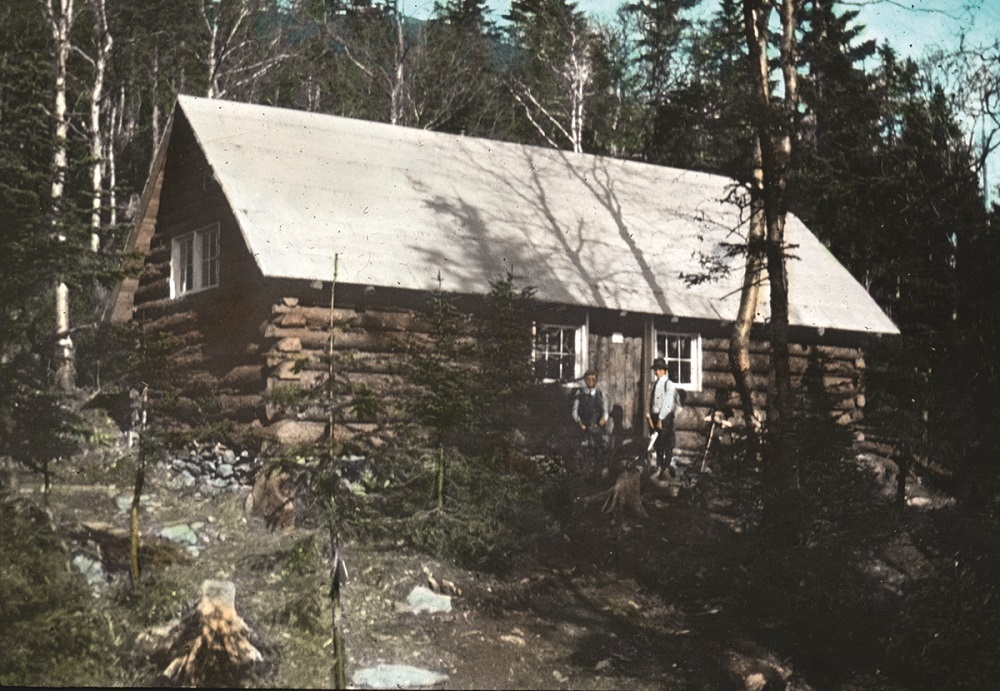
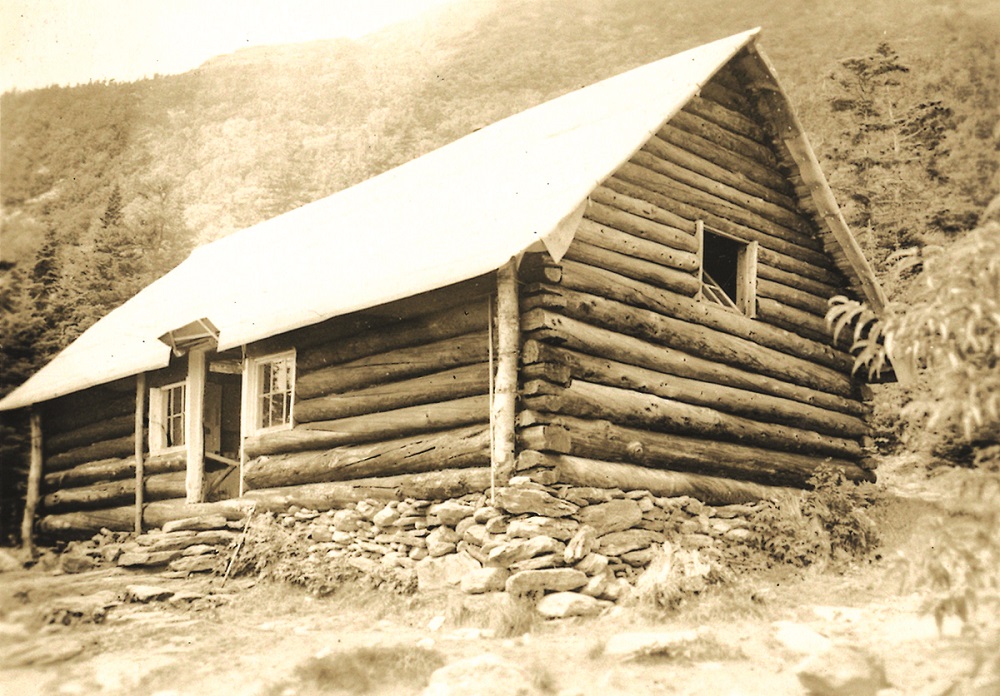
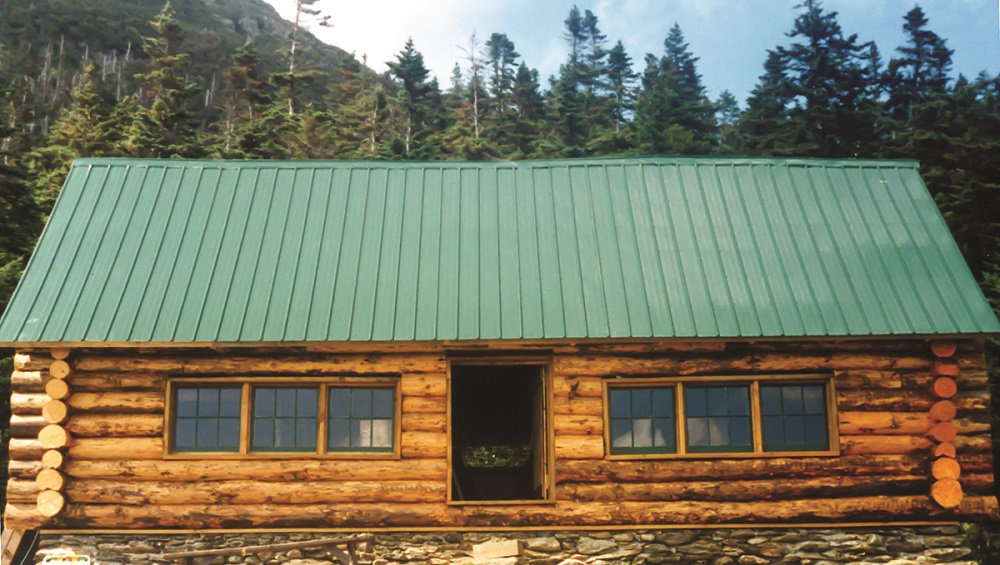
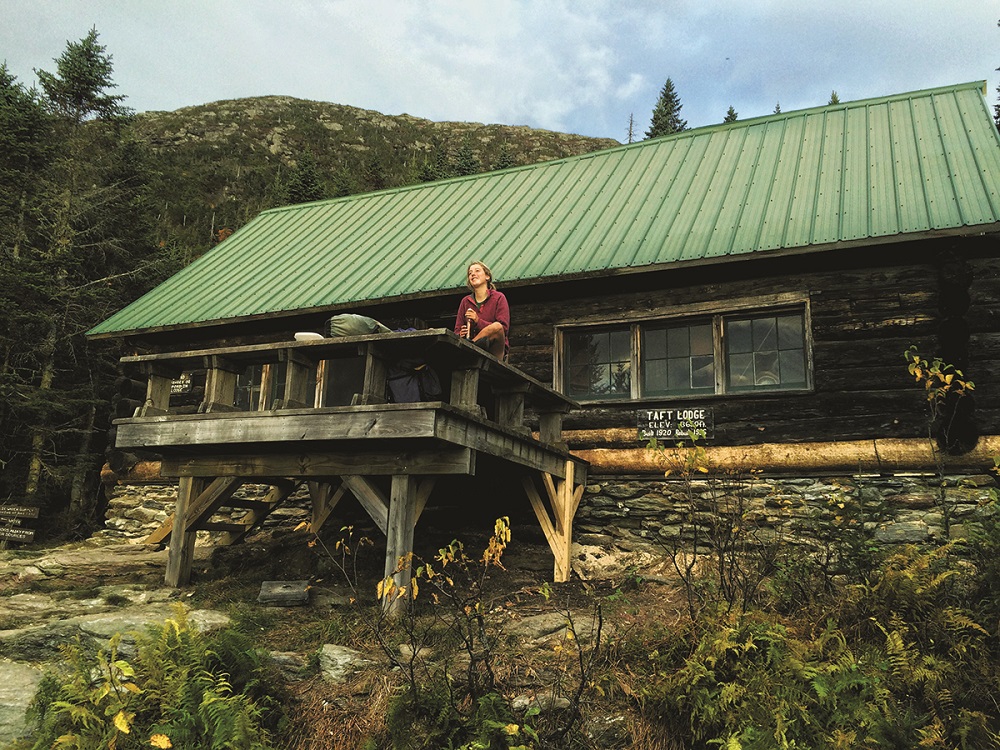
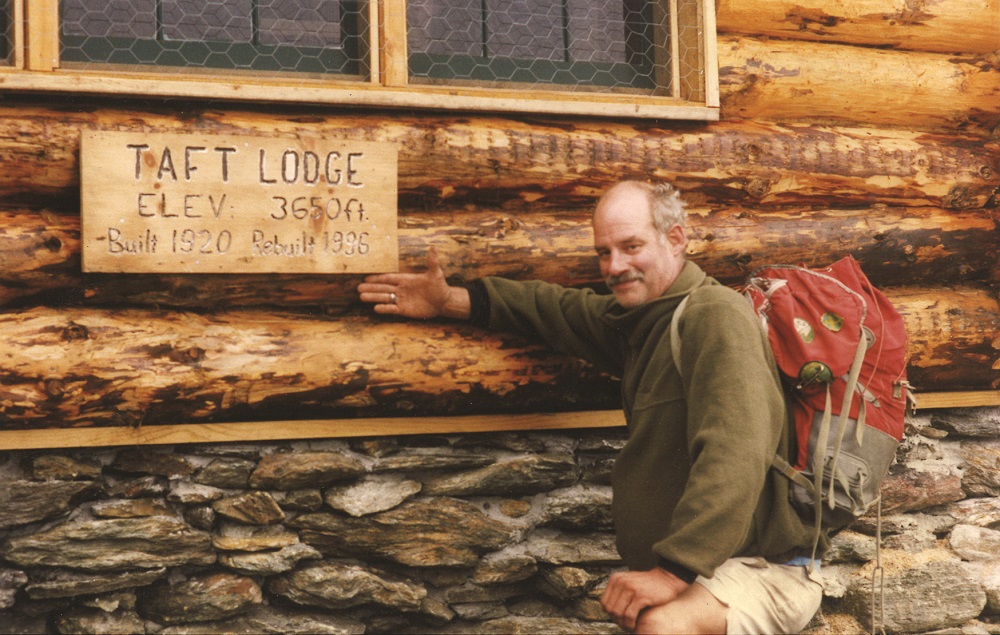
    This article was written by John Page and previously appeared in the Summer 2020 Long Trail News. Before 1910 the Summit House hotel at the top of the toll road from Stowe was the center of hiking activity on Mount Mansfield. Guests driven to the hotel spent their days exploring the top of the mountain, and many of today’s side trails around the main ridgeline date from that period. Burlington area mountain enthusiasts could also stay in a smaller hostelry on the Underhill side called the Half Way House, which maintained a bridle path to the ridge near the Summit House (now the Half Way House Trail). No trails reached the Chin directly from the base of the mountain. The only way to the summit was to ascend to the Summit House from either side, and then walk the ridge. Burlington attorney Clarence Cowles was one of the mountain enthusiasts from Burlington who enjoyed exploring Mansfield from these hotels. When James P. Taylor convened the first meeting of the Green Mountain Club in 1910, Cowles attended and signed up as a charter member. In the next seven years, Cowles personally cut the original Long Trail from Mount Mansfield to Camel’s Hump and then, as a key colleague of Will Monroe, helped extend the trail all the way to Middlebury Gap. For this alone, Clarence Cowles deserves a place in the GMC hall of fame. Cowles’ work as a trailbuilder wasn’t finished, however. In 1920 he supervised the building of Taft Lodge on a secluded shelf at 3,650 feet, in the shadow of Mount Mansfield’s Chin.  On a scouting trip the previous winter he had “slashed a tree with a blaze and there marked what he believed to be the finest location for a shelter.” He hired Stowe lumberman Willis Barnes and foreman Clyde Brink to construct a large log cabin from huge spruce logs drawn up the mountain with teams of horses. Cowles climbed Mount Mansfield thirty-one times that summer to personally supervise the project and, on one occasion, to carry the new lodge’s wood stove up the mountain. By now Cowles was a probate judge. He persuaded Elihu Taft, his fellow judge and mountain lover, to donate the construction costs for Taft Lodge, even though, as Cowles’ son put it, “old Judge Taft was then unable to climb mountains, he couldn’t have gone to Taft Lodge if we’d hauled him up.” Taft Lodge was immediately popular with hikers, particularly those from around Burlington. It had an overnight capacity of thirty-two (divided into men’s and women’s ends), and one report says up to seventy slept in and around the shelter one night.  For the next seven to eight summers, Cowles and his sons served as caretakers at Taft Lodge, providing blankets, wood, and water to hikers, while using their days to build the trails still used by hikers to ascend Mount Mansfield. While Taft was being built, Cowles blazed the current Long Trail from Smugglers’ Notch to the summit, thus finally routing the Long Trail over the Chin.  (It had previously bypassed the ridge, requiring a 2-mile side trail to the summit.) Cowles needed a more direct route to Taft from his home in Burlington, however, so the next summer he built his masterpiece, the Sunset Ridge Trail, which many today consider the premier hiking trail in Vermont. The part of this new trail that extended from the ridge down to Taft became the Profanity Trail. A few years later, Cowles built the Cowles Cut-Off from the site of the Half Way House to provide an even more direct route from Underhill to Taft Lodge. The Green Mountain Club later renamed this trail after Judge Cowles’ wife, Laura, who was an accomplished hiker in her own right and the first president of the Burlington Section. During his years of activity at Taft Lodge, Cowles and his sons also improved and blazed an old path up the Hell Brook drainage, providing yet another direct (albeit steep) route to the Chin from Smugglers’ Notch. Thus in a few short years, Clarence Cowles created a network of trails that shifted hikers’ focus from the Summit House to the Chin. Quoting Cowles’ son again: “Father’s trails always aimed up toward the chin of the mountain and Taft Lodge.” World War II ended the use of caretakers at Taft Lodge until 1969, when the modern caretaker program began. The lodge was substantially rebuilt in 1951 and again in 1996. Although it appears today much the same as the original structure, it’s unclear how much of the original fabric remains. The biggest mystery about the construction of Taft Lodge?  Why is the door so low that it dents hundreds of heads every summer?
    Taft Lodge, 1920s
    Taft Lodge, 1940s
    Taft Lodge, 1996
    Taft Lodge, 2016. Photo by Gus Billard.

    Fred Gilbert, 1996
    Fred Gilbert “Paul Bunyan” of the 1996 Taft Lodge Restoration In 1996 Taft Lodge had not been renovated for 35 years and was badly in need of repair. The Green Mountain Club hired Alfred “Fred” Carlton Gilbert III to completely restore the lodge that summer and fall. A long-time GMC volunteer, Fred was a club director and served on the trails and shelters committee for years. He died at age 73 on June 1, 2019, leaving an indelible mark on the Green Mountain Club. GMC’s archives house Fred’s detailed journal on the Lodge reconstruction. A couple of loose pages dated 1995 tucked into the journal express Fred’s fervent hope of landing the job: “…I may be attaining my life-long dream next year… I’ll be supervising the replacement of Taft Lodge on Mt. Mansfield. To be a Paul Bunyan in 1996! To be a revered personality in the veritable Green Mountains. Me, lowly, loving, me. I really hope all things work out.” In January, fifty 20-foot spruce logs were delivered to Barnes Camp at Smugglers’ Notch. Teams of horses did not pull the logs up the mountain as in 1920. On May 8 and 9 the Vermont Army Air National Guard made 60 helicopter trips to carry those logs, plus 60 ten-foot spruce logs, 100 hemlock boards, metal roofing, mortar mix, tools, and other supplies, to a landing site about 700 feet above the lodge. Fred and his assistant, John Bennett, moved to the mountain on May 14 bringing with them twelve gallons of gas and other supplies. “Beautiful stars and Milky Way at 3AM,” Fred wrote on May 15, after two trips to the outhouse. It was a welcoming first night of several months to come of living out his dream and working on the mountain. Throughout his journal, Fred recorded good progress in the rebuilding of the lodge with the help of many volunteers. There are humorous, personal thoughts too: “Great book this ‘Men are from Mars, Women are from Venus.’ Lots of interesting input!” In October, fifty people hiked to Taft Lodge to celebrate its completion and rededicate the shelter. In 2016 Taft underwent substantial renovation again, this time led by Kurt Melin. Today, 100 years after its first logs were cut and peeled, the lodge still stands steadfast on the western slope of Mount Mansfield. Thanks to Fred and others like him, it will be there to shelter hikers for decades to come.
  • Leverage: It’s Not About Size or Strength

    This article was written by Rosalie Sharp, 2019 Long Trail Patrol Leader, and previously appeared in the Fall 2019 Long Trail News.
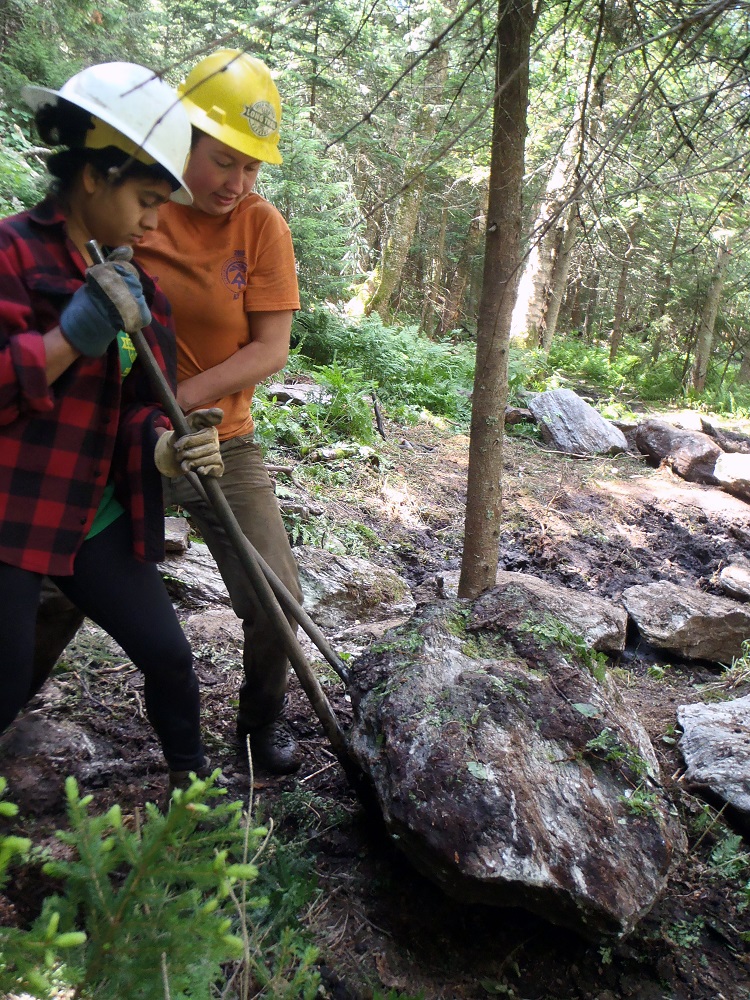
    Family and friends typically struggle to understand what I mean when I say I lead trail crews. I’ve found the quickest way to create an image is to tell them something like “My crew and I find boulders in the woods, move them onto the trail, and set them in the ground to make structures that prevent erosion.”

    That’s a simplification for sure, since we do more than stonework, but it fairly represents most Long Trail Patrol projects. Vermont trails are often steep, rocky, muddy, or some combination thereof. Stone structures are usually the best way to concentrate hiking traffic on a durable and well-drained surface. And ‘boulders’ is no understatement—the rocks we use are truly massive.

    How can a crew of four move such big rocks? With the right tools! Generations of trail builders have moved boulders with hand tools since Long Trail construction began. The Long Trail Patrol continues to use rock bars and pick mattocks almost daily. While rigging systems help bring rocks to the trail, the rock bar and the pick are the most essential tools. We could do any of this season’s stone projects with just them and a sledgehammer. They’re simple, but powerful.

    Of course, they must be wielded effectively. A bar rightly placed can flip rocks no human could budge with muscle alone. Physical strength is an asset, but it’s not the most important one. Using tools wisely, we can lift heavier loads, with less strain. That’s essential for anyone hoping to do trail work for more than a couple years, and to avoid back problems before 30.

    A rock bar is simply a lever. Placing the beveled end under a rock and prying up or down gives a worker substantial mechanical advantage. The closer the rock to the fulcrum, and the farther away we grip the bar, the less force we need to move the rock.
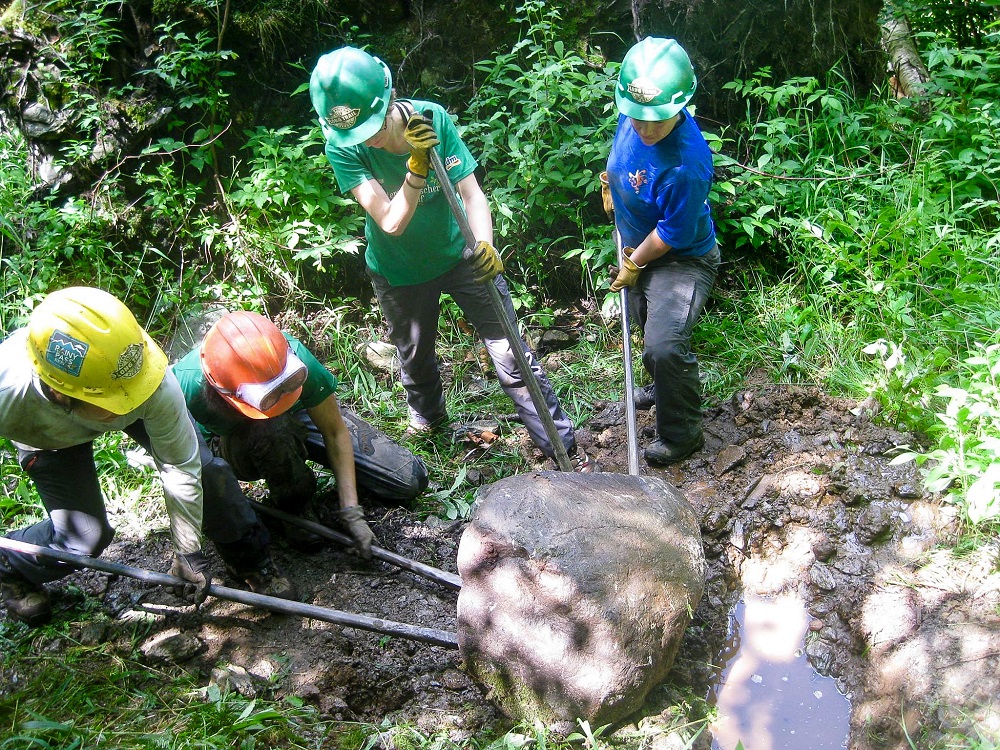
    As a worker starts rolling a big rock, they can lift only so far before the bar must be repositioned for another lift. This requires teamwork: another crew member places a bar to hold or move the rock further while the first person repositions. They take turns until the rock flips, then repeat the process. When the rock nears its final location, workers must plan their movements to place the rock properly in the hole they’ve dug, all of which requires foresight, precision, and a good sense of how that rock will behave.

    Which brings me to the pick mattock, which is a combination lever and digging tool. The mattock end can dig a rock out of the soil, moss, and leaves where it starts, and also dig the hole in the trail where it will finish. The pick end is the lever. However, because the handle is perpendicular to the pick, using a pick instead of a bar requires forces in different directions. Workers usually use a bar to move rocks up and away, but a pick works best to move rocks up and toward a worker. Predicting the forces to apply to our tools enables us to move rocks through the woods efficiently, accurately, and safely.
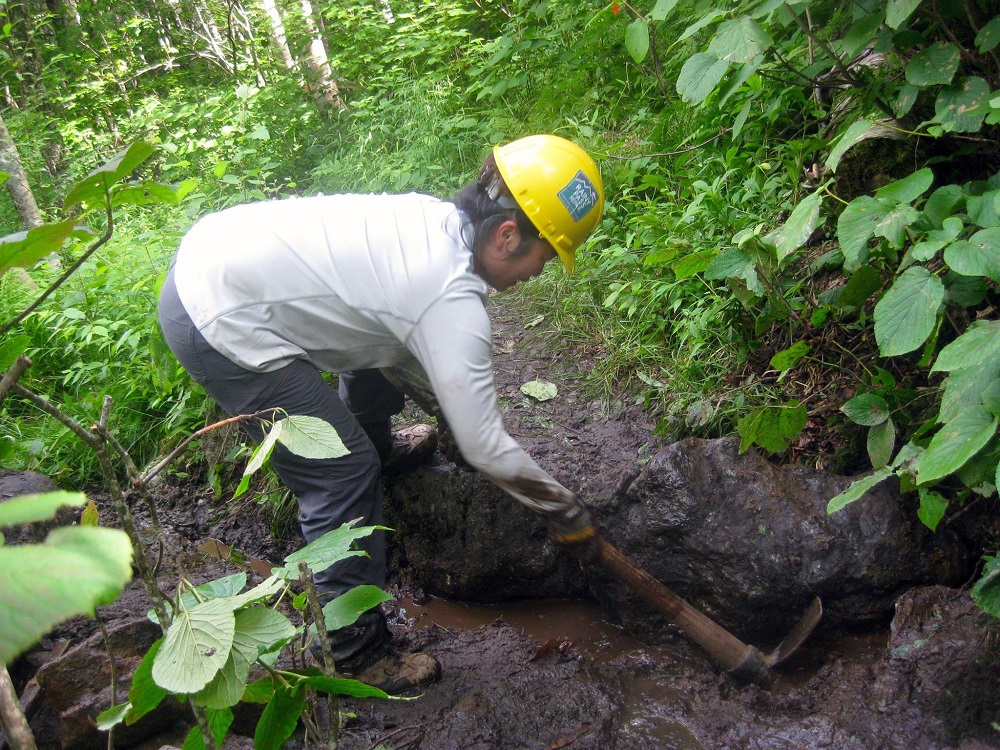
    Building skill and confidence with these tools can be incredibly rewarding. Last summer I approached three Green Mountain Club volunteers struggling to lift a rock the size of a tractor tire from a deep, boggy section of soil. Their rock bars kept slipping through the mud, deer flies buzzed above, it was at least 80 degrees, and they were understandably tired and frustrated. “We’re not strong enough to move this rock,” they declared.

    But they were strong enough. What they needed was strategy. We set smaller rocks for fulcrums so our bars wouldn’t slide through the mud; we planned where to place our bars; and we focused on communicating clearly. Within 20 minutes we had that rock flipped out of the hole, and they were rolling it down to the trail with renewed energy and confidence.

    Those three volunteers were women. Unfortunately, their belief in weakness is common among women new to trail work. Women trail workers often, though not always, have less upper body strength than many men, so they tend to feel less capable. That’s how I was at first, but I’ve been fortunate to work with extraordinary women who showed me that small size and limited strength need not be a disadvantage. I’ve never been very good at moving rocks by hand, but that pushed me to learn how to choose and use the right tools. I’m much stronger now than when I began rock work, and choose using tools over my hands most of the time. I’m a faster, safer, and healthier trail worker because of it.

    Nearly every stone structure on the Long Trail was built with rock bars and pick mattocks, and many have lasted decades. The tools are timeless, simple, and essential to working on Vermont trails. Long Trail Patrol crews will be using them all over the Green Mountains this season. Come, find us, and see some rock moving in action!
  • Problem Bears? Or Problem People?

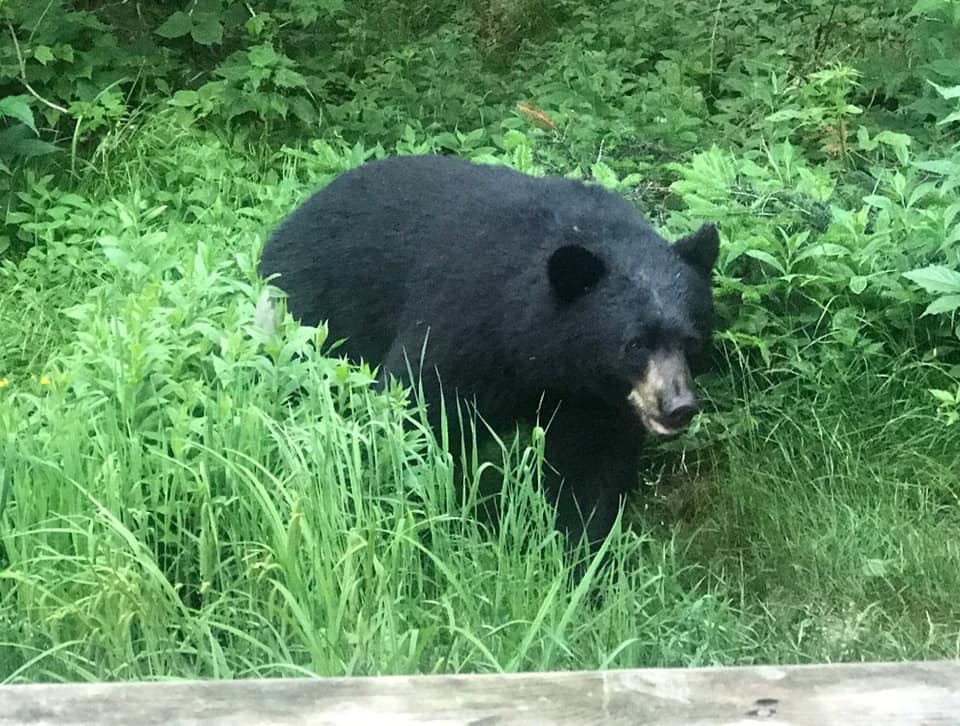
    black bear walks through tall grasses
    Black Bear at Goddard Shelter, photo by hiker Ruth “Chocoholic” Morley
    Vermont hiking trails have long been perceived as places where you don’t need to worry about bears. People hiked, camped, and cooked and stored food without concern. Times have changed, and with the increase in the black bear population, hiker behavior needs to change too. In recent years we have experienced bear problems at several areas on the Long Trail, including Stony Brook Shelter, Montclair Glen Lodge, Hump Brook Tenting Area, Bamforth Ridge Shelter, and Journey’s End Shelter, to name a few.
    bears in privy
    Bear in Goddard Privy, photo by hiker Ruth “Chocoholic” Morley
    In 2019, we had bear problems at Kid Gore, Goddard, and Stratton Pond Shelters. The bears at these locations did not react or show fear when yelled at or when stones were thrown in an attempt to scare them off. They got into several hikers’ food supplies, ripped apart a privy that had a moldy loaf of bread thrown in it, and sniffed into a shelter one night—leaving only after a startled hiker smacked the bear in the head with a trekking pole. Most black bears are wary of humans and shy away, but food-conditioned bears are potentially threatening to humans, and, if determined to be a nuisance, may be shot. This is the last thing we want, so before you head into the backcountry, take time to educate yourself about bear behavior and avoid putting them, yourself, or future hikers at risk. GMC staff work with the Vermont Fish and Wildlife Department and wildlife officials on the Green Mountain National Forest to address current bear issues and plan for improvements at the shelters and other overnight sites. We ask that you help by being prepared and taking some simple precautions.

    How to Store Food in Bear Country

    When you step into a shelter, you might see an inverted tin can tied to a string that hangs from the ceiling. These “mouse hangers” are affixed by hikers, not GMC staff. They are intended to suspend food bags and backpacks to keep them safe from mice and other pesky critters looking for goodies and salt. But guess who is also interested in your food, and can reach those hangers? Bears. With the change in bear activity and incidents on the trail, we ask that you remove the strings and cans from the shelters (and don’t add new ones). This will be a good first step to detracting bear visits to the shelters. How, then, do you secure your food?  As of summer 2019, one of these options is required in the Green Mountain National Forest. Here are some options, from most secure to least secure:
    • If a bear box is available at a designated overnight site, use it. Food and other scented items (toothpaste, deodorant, chapstick, sunscreen, etc) should be stored away. Make sure the box is closed and latched. See the list of all overnight sights with bear boxes on the Long Trail and Appalachian Trail.
    • GMC strongly recommends that hikers carry a bear-resistant food storage container. There are a variety of them available; some are more effective than others. Know how to use yours correctly, leave it closed and locked, and stash it at least 100 yards from your—or anyone else’s—shelter. Don’t put it near a cliff or water source or a bear might bat it over the ledge or into the water. Check the Interagency Grizzly Bear Committee website for approved personal food storage options.
    • Hang a bear bag from a tree limb. This is very often done incorrectly and finding a suitable branch is difficult in our dense forests. However, if it is your only option, make sure food bags are hung 100 yards away from the shelter and all tents in the area.
    *A Food Storage Closure Order for the entire Green Mountain National Forest (GMNF) aims to minimize black bear and human encounters and interactions. The order specifies proper food storage and prohibits leaving food or refuse on National Forest system lands in Vermont. The Order was issued to provide for visitor safety and the conservation of bears. Find more information in the press release; this order is still in effect (summer, 2021). If a bear is successful at getting into your food, please report it to GMC and Vermont Fish and Wildlife. If you see a bear in the vicinity of a designated campsite on the Long Trail, please notify GMC.
    food wrappers left in composting bin would attract bears
    Trash in a composting bin at Bamforth Ridge Shelter

    How Humans Should Behave in Bear Country

    • As the bear at Goddard Shelter who tore apart the privy demonstrated, bears are not particular about where discarded food is. Do not throw food or trash into the privy or composting bins. (Also, our caretakers have the unpleasant task of removing these items from the waste bin later.)
    • Pack out all garbage and food scraps and do not leave any trash in the bear boxes. There are no trash cans on the trail, and there is no one to collect your trash. If you see trash in the bear boxes already, please consider packing some out with your own garbage.
    • While Trail Magic can be a wonderful and welcome gesture, do not leave extra food in the shelters or unattended alongside the trail. The bear at Montclair Glen Lodge busted the door open and went inside searching for some magic.
    • Cook meals away from your tent or shelter, and do not eat in your tent or shelter.  Keep tasty smells away from where you sleep.  Secure food as listed above.
    • Do not feed or approach bears. Intentionally feeding bears is illegal.
    • If you encounter a bear in the trail, follow these recommendations from the Vermont Fish and Wildlife Department:
      • When the bear is unaware of your presence you should:
        • Quietly back away from the bear and leave the area.
        • DO NOT approach the bear.
      • When the bear is aware of your presence and is uninterested you should:
        • Quietly back away from the bear and leave the area.
        • DO NOT approach the bear.
      • When the bear is curious and continues to look in your direction, smells the air, or slowly approaches you should:
        • Talk in a calm voice while slowly backing away from the bear.
        • DO NOT approach the bear. If the bear is defensive it may:
          • Make vocalizations which can include huffing and jaw popping.
          • Retreat up a tree.
          • Swat at the ground or tree.
          • Lower its head with ears flattened, and sways back and forth.
      • When the bear is defensive you should:
        • Begin repeating “Hey bear” in a calm voice.
        • Back away and leave the area.
      • If the bear continues to be defensive or becomes aggressive it may:
        • Approach you.
        • Begin to follow you.
        • Charge you.
      • When the bear is aggressive you should:
        • Make yourself look bigger by putting your arms above your head. Continue to repeat “Hey bear” in a calm voice. Back away and leave the area.
        • If it continues to follow you, stand your ground, make yourself look bigger, shout at the bear, threaten the bear with whatever is at hand (bang a stick on the ground, clap your hands), and prepare to use bear pepper spray if it is available.  Back away and leave the area.
        • If charged, stand your ground, talk to the bear in a calm voice and use bear pepper spray when available.  If the bear makes contact with you, fight back using anything you have (e.g. stick, binoculars, etc.).
    For even more information about bear behavior and what to do in certain situations, check out this FAQ.

    GMC’s Bear Plans

    In 2019,  the bear that tore apart the privy at Goddard Shelter was a concerning incident.  In response to this, GMC immediately installed a bear box for secure food storage for hikers, reinforced the privy door to make it harder for a bear to enter into the privy, picked up all trash within 150 feet of the shelter, and placed informational signs at the shelter, privy, and bear box on the importance of properly storing food, keeping a clean camp, and how to handle an interested bear.  Since then, this particular bear has taken two backpacks from hikers and destroyed two tents looking for food. Goddard Shelter was closed while game wardens from Vermont Fish and Wildlife tracked down and shot the bear. It is now reopened, but please continue to practice safe food storage as outlined so we can avoid this outcome in the future. GMC evaluates food storage options on a site-by-site basis and intends to create secure, efficient, and easy-to-operate food storage systems for most overnight sites. In the meantime, human behavior will determine whether Vermont’s black bears become “problem bears” or remain the shy and elusive creatures they started as.  Please do your best to be part of the solution and to educate others on bear safety.  This will create a safer trail for hikers and a safer environment for bears.

    GMNF Food Storage Closure Order

    The following acts are prohibited on the Green Mountain National Forest:
    1. Except while being consumed, all food, food containers and refuse shall be stored in a closed motor vehicle or suspended at least twelve (12) feet above the ground and not less than six (6) feet horizontally from any object. Bear boxes and bear canisters designed specifically for food and/or refuse storage are acceptable.
    2. All refuse containing food materials or containers shall be deposited in receptacles provided for that purpose, removed from the Green Mountain National Forest to be disposed of properly, or stored in the manner prescribed for food in #1 above (36 CFR 261.58(cc)).
    We have had many questions about whether Ursacks are allowed with the GMNF order. Ursacks are currently acceptable under the Food Storage Closure Order, but as with any newer device or technology, they could be unacceptable in the future if GMNF sees issues with them. We recommend that they be used in conjunction with the odor-proof OPSaks recommended by Ursack.   This article was contributed to by Jocelyn Hebert, Keegan Tierney, Kristin McLane, and Lorne Currier.