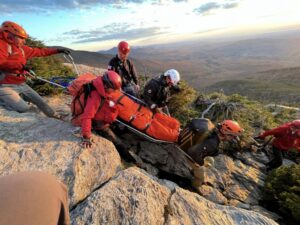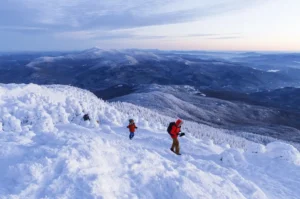

On February 7, 2026, several local rescue teams, including Waterbury Backcountry Rescue Team (WBRT) and Camels Hump Back Country Rescue Teams (CHBCRT), responded to a call for help by two hikers on Camel’s Hump as winter conditions became increasingly urgent and dangerous. This article was written by Michael Chiarella (WBRT) and Brian Lindner (CHBCRT).
Learn more about this call for help, the ensuing rescue, and how the volunteers handled the extreme conditions during Rescue Review with Camel’s Hump Back Country Rescue Team on November 17 from 7-8:30 p.m, hosted at GMC Headquarters. Michael Chiarella will also talk about lessons learned, and cover hypothermia and frostbite care. This all-volunteer organization is accepting optional donations in lieu of a registration fee.

The winds were strong all day, especially in the mountains, and with the wind chill much of central Vermont was hovering around -30ºF. It was pitch dark at 5:57 p.m. when 911 took a call from two hikers on the Long Trail just south of the summit of Camels Hump. One of the hikers later said, “A mistake we definitely made was not looking at the weather past 3 p.m.”
The call was funneled to Drew Clymer, Vermont’s Search and Rescue Coordinator in the Department of Public Safety. Clymer recognized this was a life-threatening situation. Not only were the two hikers in danger, but rescuers were now also going to be at risk in brutal winter conditions. Rescuers would have to hike up, find the individuals, and guide them to safety. The couple was already cold and having difficulty moving, their water bottles were frozen, they had been wallowing in the snow since 9:30 a.m., and temperatures were predicted to continue to fall.
Clymer’s next call was to the Waterbury Backcountry Rescue Team (WBRT), the team closest to the trailhead. WBRT’s team leader, Eric LaRose, also recognized the seriousness of the situation and began to mobilize his team. By phone, Clymer and WBRT confirmed the hikers were near the Long Trail and Alpine Trail intersection — just below tree line. Clymer convinced the hikers they had to actively participate in their own rescue, as time was critical in the arctic cold. The hikers had to continue uphill then turn right onto the Alpine Trail as their fastest route to safety.
The two hikers were a 20-year-old male and a 19-year-old female. They had recently met online, and share a mutual love of hiking and were experienced recreating outdoors. Arriving at the base of the Monroe Trail in Duxbury, they had begun their climb around 9:30 a.m. They proceeded up the Monroe Trail then onto the Dean Trail, heading to Wind Gap where they planned to turn right and continue up the Long Trail headed toward the summit.
The trail up to Wind Gap had been partially packed by previous hikers, but when they turned onto the Long Trail, the snow quickly became deeper and less packed. They were in three-season hiking boots without snowshoes facing ever deepening drifts. The male (we’ll call him Reilly) later said, “It was near impossible to cover any ground because of the depth of [the] snow.” His friend, “Charlotte,” said he, at 6’1,” had to break trail as she sometimes clung to his pack to be pulled through the drifts.
The couple struggled uphill to the Alpine Trail and according to Charlotte, “We didn’t realize that the sun was setting until we actually saw the sunset because we were having such a great time.” Soon, however, in the rapidly approaching darkness and extreme cold, they recognized their situation was getting worse. Charlotte later said, “Things started to go wrong really fast.” They discussed calling 911 but decided not to in fear of being charged for a rescue. Then their one headlamp failed.
Around 8:00 p.m., they finally reached the Alpine Trail and began their descent. Their water was frozen and their snacks so solid that trying to break off a bite proved to be impossible. Twenty minutes later, Reilly reported that Charlotte had collapsed and was now in the snow just below tree line. Help was still hours away. Trail conditions between the hikers and those who could save them were described as “horrendous.”
By this time, WBRT had called for mutual aid from their partner teams, Camels Hump Backcountry Rescue Team (CHBR) from Richmond and Huntington Backcountry Search and Rescue (HSAR), who all routinely train and support each other in back country rescues. All rescuers paused upon hearing one hiker was down. There was no longer any question that this mission was a clear matter of life and death.
The first rescuers arrived dressed and packed for a nighttime rescue far up Camel’s Hump in arctic cold with terrible trail conditions and one victim already incapacitated. Team 1 headed up with snowshoes. Even in winter, most rescuers routinely shed clothing during the ascent — not this night, it was far too cold. Team 1 had to plow uphill through drifts waist deep. They post-holed at virtually every step, even with snowshoes.
While Team 1 struggled uphill with members from CHBR and WBRT, Team 2 assembled and left the base with a litter for use in bringing Charlotte to safety. They departed the base just after 10 p.m. with members from CHBR, HSAR, and WBRT.
At 11:32, Team 1 reached the hikers — nearly six hours after their call to 911. Reilly told rescuers he was unsure he’d be able to move downhill on his own. Team 1 immediately recognized they were going to struggle just to evacuate the nearly unconscious Charlotte and adding the 6’ 1” male to that equation spelled “impossible.” Rescuers firmly told Reilly he had no choice. His survival depended on his participation. After consuming much of the rescuer’s fluids, he agreed to try.
Team 1 began to treat Charlotte as they awaited Team 2’s arrival with the litter. Other members of Team 1 took Reilly and began guiding him downhill at 12:24 p.m. while others stayed with Charlotte and attempted basic rewarming with a sleeping bag, heat packs, and space blankets. She had lost all ability to participate in her own rescue.
At 1:15 a.m., Team 2 arrived on scene with the litter. Charlotte was moved into a special hypothermia bag, secured in the litter, and at 1:40 a.m. the team began downhill. This, too, was exhausting. The team had to pull her downhill through the deep snow. All rescuers realized this would fully test their abilities, and if any one of them became injured or incapacitated, the entire situation could become even more deadly.
Reilly struggled downhill with assistance and reached the Command Post at 2:14 a.m. He had significantly rewarmed from the effort and despite frostbitten feet, decided he did not wish to be taken to the hospital.
A full hour and a half later, Charlotte was brought to the base and immediately moved into an awaiting ambulance and taken to the UVM Medical Center. The battle was on to save her seriously frostbitten toes and feet. The hospital was successful and discharged her within days. She returned home, but moved with a crutch and suffered from a loss of sensation in both feet. Reilly also suffered a loss of sensation but expected a full recovery.
The exhausted rescuers returned home realizing just how seriously they had been tested. Vermont Search and Rescue Coordinator Clymer presided over a case review a few days later. He opened the meeting saying, “You all saved those two hikers. If it hadn’t been for you, they would have died on the mountain that night. No question.”
Charlotte and Reilly later discussed their case with Mike Chiarella of CHBR. They were both very candid and honest. They readily admitted they had not prepared well, had not looked sufficiently at the forecast, weren’t dressed appropriately, and should have called 911 far earlier. They and their rescuers all hope the story of their near-death will help others to avoid the same mistakes.
Hike Safe This Winter
Do your part to show up to the trails well prepared for winter conditions! Learn how you can set yourself up for a safe hike and successful rescue in the case of an emergency.